
If you want to study at a university in the United States, sooner or later you will hear about the SAT. It is one of the two big admissions tests used by American universities, and for many international students it is also the first exam they have ever taken in a language that is not their own.
The good news is that the SAT is a very predictable test. The format is fixed, the question types repeat, and the best preparation material is free and published by the people who write the exam. With a clear plan and a few months of steady work, most students can improve their score significantly. Here is how to do it, step by step.
What the SAT Is, and Who Needs It
The SAT is a standardised test run by the College Board, a non-profit organisation in the United States. Universities use it to compare applicants who come from very different schools, countries and grading systems, which is exactly why it can matter so much for international students: a strong score shows admissions officers how you compare with everyone else, whatever your school's grades look like.
For a few years, many American universities went "test-optional", meaning you could choose whether to send a score. That is still the case at many universities, but a growing number of selective ones, including MIT, Harvard, Yale and Dartmouth, now require test scores again. Even where it is optional, a good score can strengthen your application and, at some universities, help with merit scholarships. Policies change from year to year, so always check the admissions page of every university on your list.
How the Digital SAT Works
Since 2024, the SAT has been taken entirely on a computer, through the College Board's Bluebook app, at an official test centre. It is shorter than the old paper test, and it works differently.
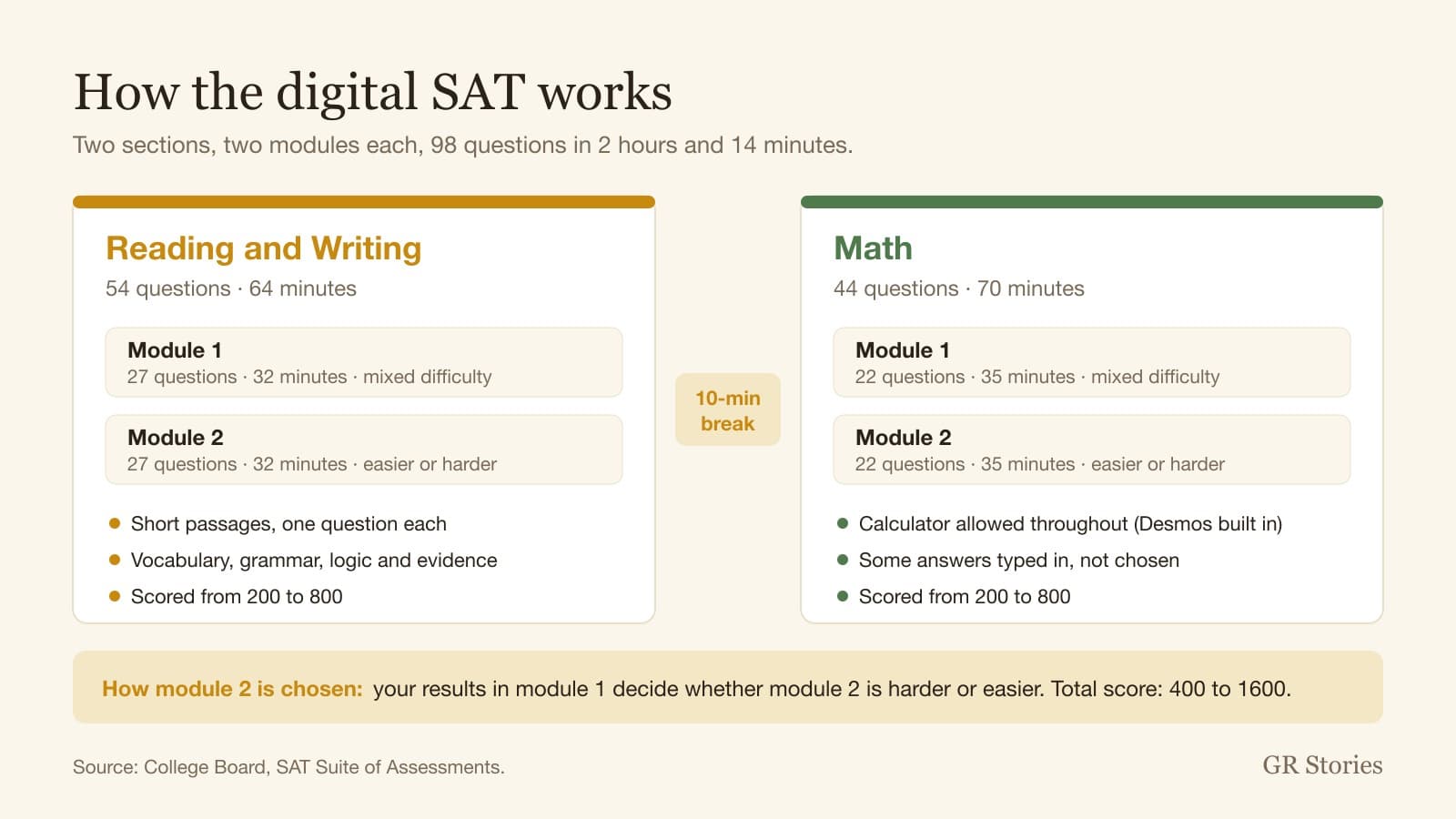
The test has two sections. Reading and Writing comes first: 54 questions in 64 minutes. Then, after a 10-minute break, comes Math: 44 questions in 70 minutes. In total, that is 98 questions in 2 hours and 14 minutes.
Each section is split into two modules of equal length, and this is where the digital SAT becomes adaptive. The first module of each section contains a mix of easy, medium and hard questions. How well you do on it decides whether your second module is harder or easier. A harder second module is good news: it is the only way to reach the highest scores.
Each section is scored from 200 to 800, for a total of 400 to 1600. There is no penalty for wrong answers, so you should never leave a question blank.
Step 1: Take a Practice Test First
Before you open a single prep book, take a full-length practice test in Bluebook. The official practice tests are free, they use the same app and the same adaptive format as the real exam, and they give you a score you can trust.
This first test is not about getting a good result. It is about finding your starting point: which section is stronger, which question types slow you down, and how you handle the clock. Take it in one sitting, at a desk, with the timer on, as if it were the real thing.

Step 2: Set a Target Score
A good SAT score is not a single number: it depends entirely on where you want to go. Look up the middle 50% SAT range of admitted students at each university on your list. Most universities publish it on their admissions pages, and the rest include it in their Common Data Set, a standard report you can find by searching the university's name plus "Common Data Set".
Aim for a score at or above the middle of that range at the universities you care about most. The gap between your practice test and your target tells you how much work you need to do, and how much time to plan for.
Step 3: Make a Study Plan
For most students, two to three months of regular preparation is the sweet spot: long enough to really improve, short enough to stay motivated. Around five to six hours a week, spread over several shorter sessions, works far better than one long session on a Sunday, because spaced practice is one of the most effective ways to learn, as we explained in How to Study Smarter at University.
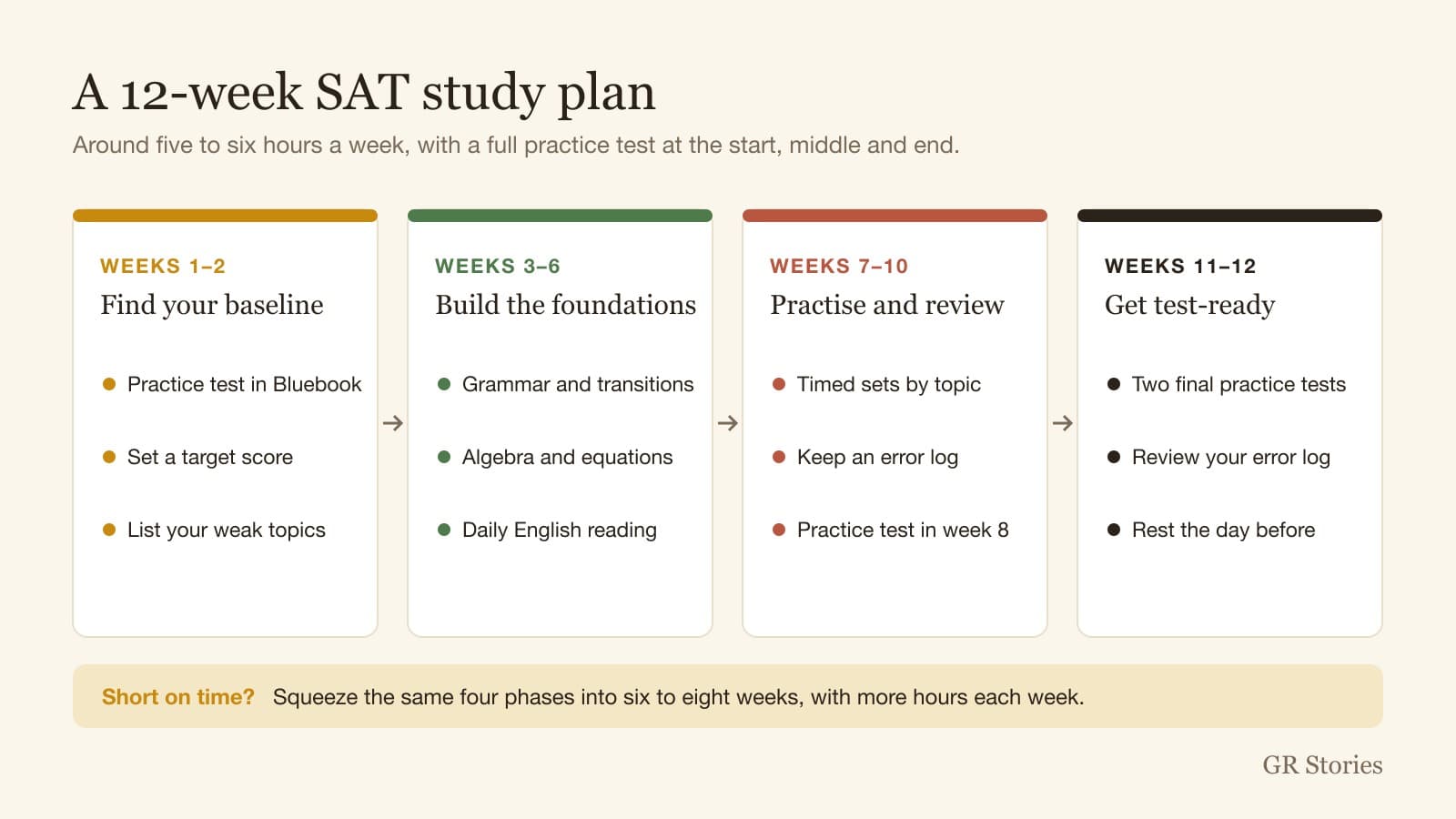
A simple 12-week plan looks like this:
- Weeks 1 and 2: take your first practice test, set your target score and make a list of your weakest topics.
- Weeks 3 to 6: build the foundations. Learn the grammar and punctuation rules the test checks, review algebra, and read in English every day.
- Weeks 7 to 10: practise timed sets of questions by topic, keep an error log, and take a second full practice test around week 8.
- Weeks 11 and 12: take two more full practice tests, go back over your error log, and rest the day before the exam.
If your test date is closer, keep the same four phases and squeeze them into six to eight weeks, with more hours each week.

Step 4: Use the Official Free Resources
You do not need to spend a fortune on SAT prep. The best material is free:
- Bluebook practice tests. Full-length, adaptive and scored, exactly like the real exam. Save them for the start, middle and end of your preparation, rather than using them all at once.
- Official Digital SAT Prep on Khan Academy. Built together with the College Board, with lessons and practice questions for every skill on the test, organised by difficulty.
- The SAT Suite Question Bank. The College Board's searchable bank of official questions, which you can filter by section, skill and difficulty. Perfect for drilling your weakest topics.
Prep books and courses can help, especially if you like having a structure, but make sure anything you use is written for the digital SAT, since the old paper version was quite different.
Step 5: Reading and Writing Tips
The Reading and Writing section is built around short passages, each followed by a single question. The questions fall into four areas: understanding the meaning of words in context, finding the main idea and the evidence that supports it, applying the rules of standard English, and choosing the best way to connect or improve sentences.
- Learn the rules. A large part of the section tests a limited set of grammar and punctuation rules: commas, semicolons, colons, subject-verb agreement, verb tenses and pronouns. Once you know them, these become some of the fastest questions on the test.
- Master transitions. Words such as "however", "therefore", "for example" and "similarly" come up again and again. Ask yourself what the relationship between the two sentences really is before you look at the options.
- Read the question first. With only one question per passage, knowing what you are looking for saves time.
- Read in English every day. For international students, this is the most powerful habit of all. Fifteen minutes a day of good journalism, science articles or essays builds the vocabulary and reading speed the test rewards.

Step 6: Math Tips
The Math section covers four areas: algebra, advanced maths such as quadratic and exponential functions, problem-solving and data analysis, and geometry and trigonometry. Most questions are multiple choice, but some ask you to type in your own answer.
- Get algebra rock-solid. Linear equations, systems of equations and functions appear throughout the section. They are the foundation for everything else.
- Learn to use Desmos. A graphing calculator is built into Bluebook, and you can use it, or your own approved calculator, for the entire section. Graphing an equation is often faster than solving it by hand, but only if you have practised it beforehand.
- Use the reference sheet. The common geometry formulas are provided during the test, so spend your memory on methods rather than formulas.
- Read carefully. Many mistakes come from answering a slightly different question: check units, and whether the question asks for x or for something else entirely.

Step 7: Learn From Every Mistake
The students who improve the most are not the ones who do the most questions, but the ones who learn the most from each mistake. Keep an error log: a notebook or a spreadsheet where, for every question you get wrong, you write down the topic, why you got it wrong and what you will do differently next time.
Over a few weeks, patterns appear. Maybe you always rush the last questions, or always confuse colons and semicolons. Those patterns are exactly what to study next. Every week, go back to a few old mistakes and redo them without looking at the answer.
Step 8: Practise the Timing
On the digital SAT, the clock is part of the challenge. Reading and Writing gives you a little over a minute per question, and Math a little over a minute and a half.
- Take module 1 seriously. It decides how hard your second module will be, so do not rush it.
- Flag and move on. Within a module, you can skip questions, flag them and come back. Do not let one hard question eat five minutes.
- Never leave a blank. Wrong answers cost you nothing, so make an educated guess on everything before time runs out.
- Remember you cannot go back. Once a module ends, you cannot return to it.
Registering and Test Day
You register for the SAT on the College Board website. The test is offered on several Saturdays a year, both in the United States and internationally, and outside the US there is an additional regional fee on top of the standard one. Seats at international test centres can fill up quickly, so register well before the deadline.

Before test day:
- Set up your device. Install Bluebook on your laptop or tablet and complete the exam setup in the days before the test, so you can download your admission ticket.
- Pack your bag the night before: your charged device and charger, your admission ticket, a valid photo ID, pencils or pens for scratch paper, an approved calculator if you want one, and water and a snack for the break.
- Arrive early. Check-in takes time, and you do not want to start the test already stressed.
After the Test
Scores are usually released within a couple of weeks. If you are not happy with your result, you are in good company: many students take the SAT two or three times. Many universities also "superscore", combining your best Reading and Writing score and your best Math score from different test dates, which makes a retake even more worthwhile.
The SAT is not a test of how intelligent you are. It is a test of a specific set of skills, in a specific format, and skills can be learnt. Start early, practise with official material, learn from your mistakes, and you will walk into the test centre knowing exactly what to expect.
Sources and Photo Credits
- SAT structure and format, College Board
- Official Digital SAT Prep, Khan Academy
- Cover: Desk, laptop, notebook and pen by Pixel.la, CC0
- Laptop and books by Kari Shea, CC0
- Journaling over coffee by Thought Catalog, CC0
- A notebook by Jan Kahánek, CC0
- Desktop with laptop and calculator, unknown author, CC0
- Laptop on desk, book stacks by Freddie Marriage, CC0
- Graphics: GR Stories