
Most students study the way they were taught at school: read the notes, highlight the important parts, read them again, and hope it sticks. It feels productive. The pages look colourful, the text feels familiar, and after a few hours you are sure you know it.
Then the exam starts, the first question asks you to explain something in your own words, and the page in your head is blank.
That gap between feeling ready and being ready is the most common trap at university, and it has very little to do with intelligence or hours spent at the desk. It is mostly about method. The good news is that the methods that actually work are well researched, free, and simple enough to start using this week, whether you study in your home country or at a European university where a single final exam can decide your grade.
What the Research Actually Says
In 2013, a team of psychologists led by John Dunlosky published one of the most cited reviews on the topic, Improving Students' Learning With Effective Learning Techniques. They took ten techniques that students commonly use and looked at hundreds of studies to see which ones held up across different subjects, ages and types of test.
The results were uncomfortable for anyone who owns a lot of highlighters.
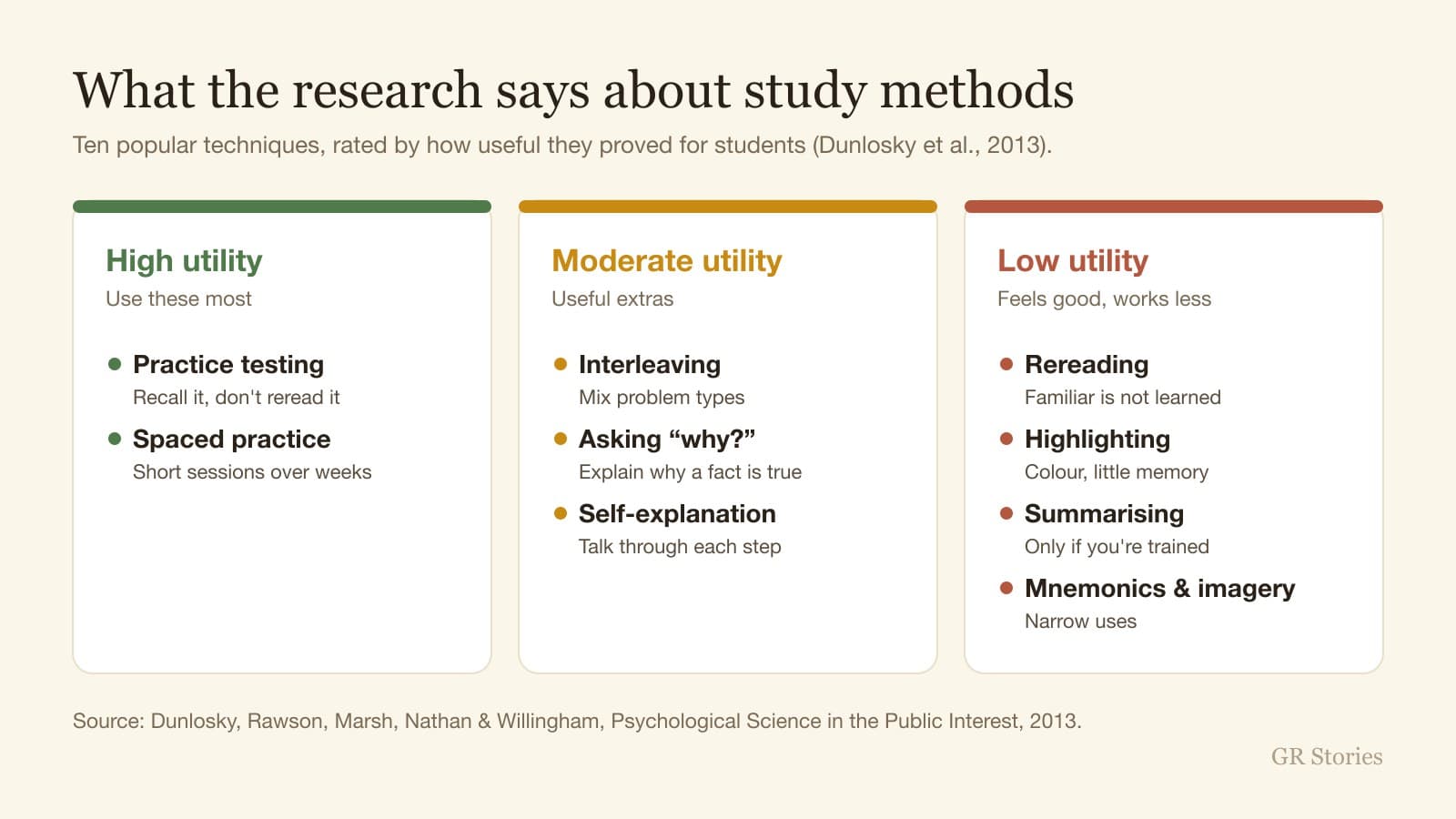
Only two techniques earned the top rating: practice testing and spaced practice. Three more were rated moderately useful: mixing different types of problems, asking yourself why something is true, and explaining each step to yourself. The most popular habits, rereading and highlighting, landed at the bottom. They are not useless, but they mostly create a sense of familiarity, and familiarity is not the same as being able to recall something under pressure.
Here is how to turn that research into a way of studying.
1. Test Yourself Before You Reread
The single most effective thing you can do is to close the book and try to remember what you just studied.
It sounds too simple, but retrieving information from memory is not just a way of checking what you know. The act of recalling it is what strengthens it. In a well-known experiment, Roediger and Karpicke (2006) had students read a short text. Some then reread it, while others spent the same time writing down everything they could remember. Five minutes later, the rereaders did slightly better. A week later, the picture flipped: the students who had practised recalling remembered considerably more, even though they had read the text fewer times.
How to do it in practice:
- Blank page method. After a lecture or a chapter, take a blank sheet and write down everything you remember, then open your notes and fill the gaps in a different colour. The gaps are exactly what you need to study.
- Turn headings into questions. "The causes of the 2008 crisis" becomes "What caused the 2008 crisis?". Answer it before you read the section.
- Flashcards, used properly. Say or write the answer before you flip the card. Recognising the answer once you see it does not count.
- Past papers. If your university publishes old exams, they are the closest thing to the real test. Do them under exam conditions, not with your notes open.
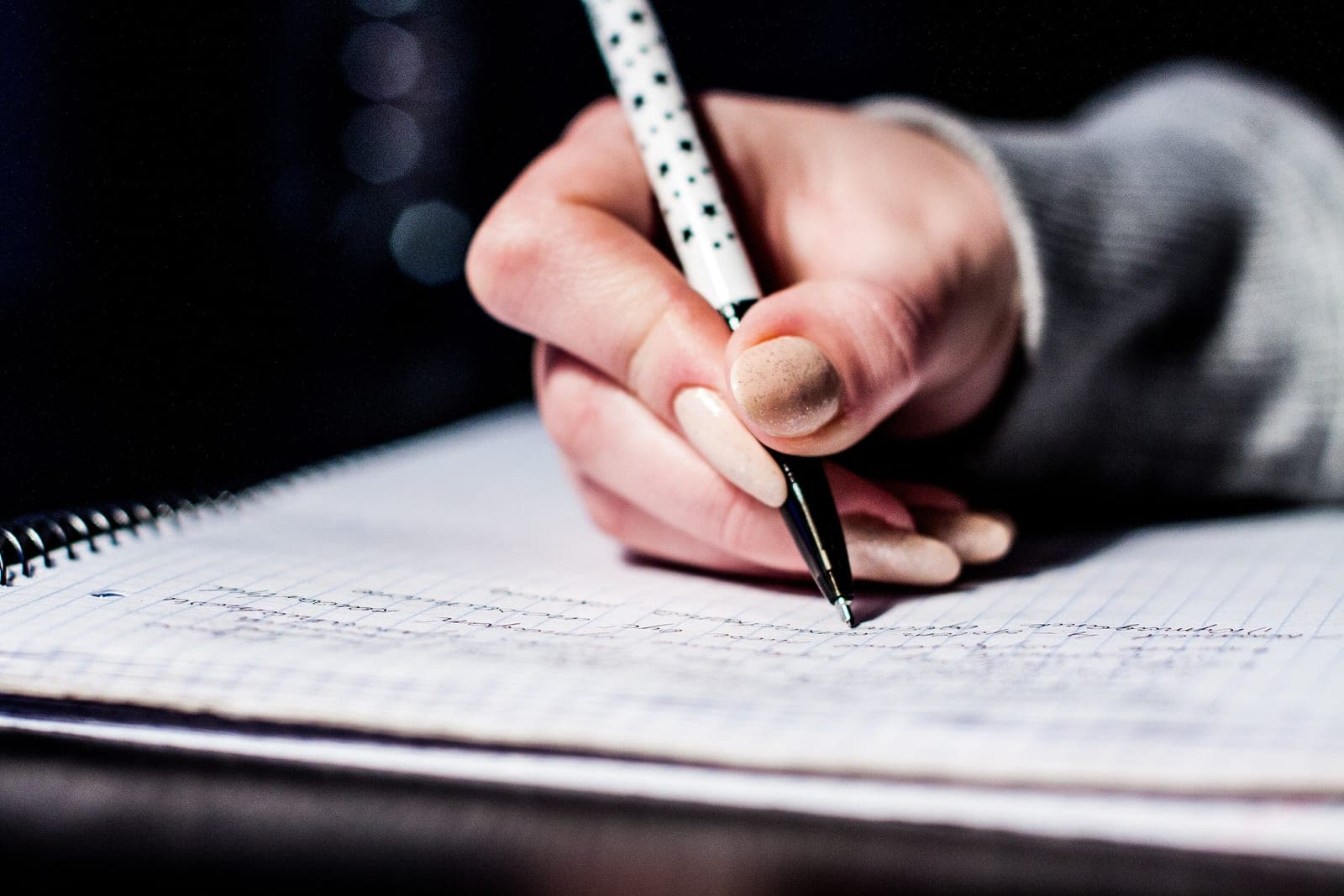
It will feel harder than rereading. That is the point. Psychologists call it a "desirable difficulty": the effort of pulling something out of memory is what makes it last.
2. Space It Out Instead of Cramming
In 1885, the German psychologist Hermann Ebbinghaus spent months memorising lists of nonsense syllables and testing himself, and described what is now called the forgetting curve: without review, we forget most new information within days. What he also noticed is that every time you review something, it fades more slowly afterwards.
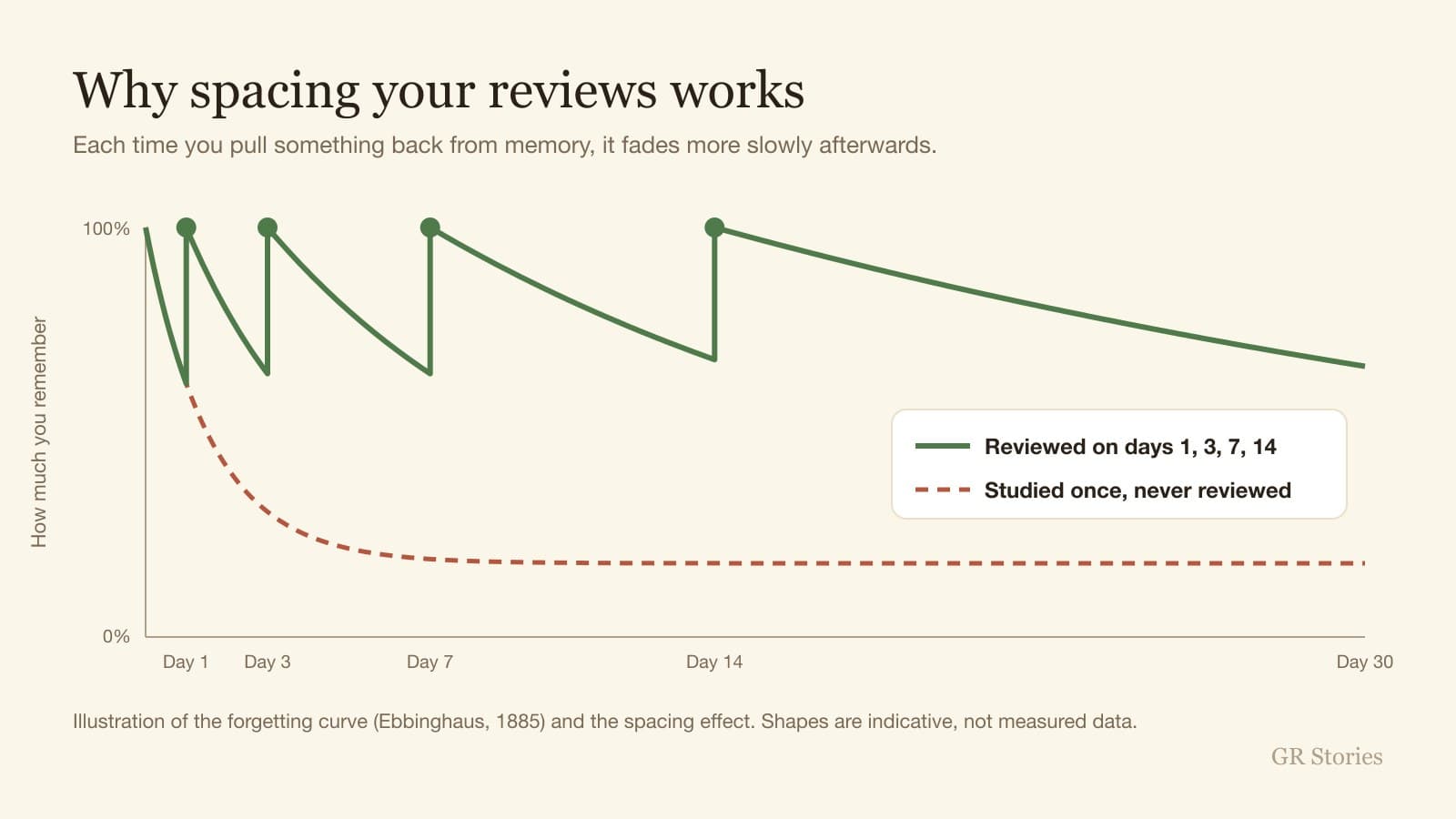
This is the spacing effect, and it is one of the most reliable findings in all of psychology. A large study by Cepeda and colleagues (2008) added a practical detail: the longer you need to remember something, the longer the gaps between reviews should be. If the exam is in a week, review after a day or two. If it is in two months, you can space reviews a week or more apart.
The same total hours, spread over several weeks, beat a marathon the night before. Cramming can get you through tomorrow's test, but most of it is gone by the following week, which is a problem when next semester's course builds on this one.
A simple schedule to start with: review new material one day, three days, seven days and fourteen days after you first learn it, using practice testing each time. Spaced-repetition flashcard apps such as Anki do this calculation for you.
3. Mix Topics and Problem Types
Most textbooks group exercises by chapter: twenty problems on one method, then twenty on the next. It feels efficient, because by the fifth problem you are on autopilot. But the exam will not tell you which method each question needs, and recognising that is half the skill.
Interleaving means mixing different types of problems in the same session, so that you have to decide each time which approach fits. It is slower and you will make more mistakes while practising, but it trains exactly the judgement that exams test. It works especially well for maths, statistics, economics, physics and anything with exercises. For subjects based on reading, you can do something similar by alternating between two or three courses in the same afternoon instead of spending the whole day on one.
4. Explain It in Simple Words
The physicist Richard Feynman is often credited with a simple test for understanding: if you cannot explain something in plain language, you do not really understand it yet. Whether or not he put it exactly that way, the idea matches what research calls self-explanation and elaborative interrogation, both rated moderately useful in the Dunlosky review.
Pick a concept, imagine you are explaining it to a friend from a different degree, and talk it through out loud or on paper. Keep asking yourself "why?" and "how does this connect to what I already know?". The moment you start waving your hands or reaching for the textbook's exact sentence, you have found a gap.
This is also where AI tools can genuinely help, if you use them to test you rather than to think for you. Ask a chatbot to act as your examiner, to ask one question at a time and to tell you what your answer missed. Our guide on how to write the perfect AI prompt has a ready-made prompt for exactly this.
5. Work in Focused Blocks
Two hours at the desk with a phone buzzing every few minutes is not two hours of study. Attention is the resource that runs out first, and protecting it matters as much as the method you use.
The Pomodoro Technique, created by the Italian student Francesco Cirillo in the late 1980s and named after his tomato-shaped kitchen timer, is a simple way to do it: 25 minutes of focused work, a 5-minute break, and a longer break after four rounds. The exact numbers matter less than the rule behind them. During a block you do one thing, and during the break you actually stop.
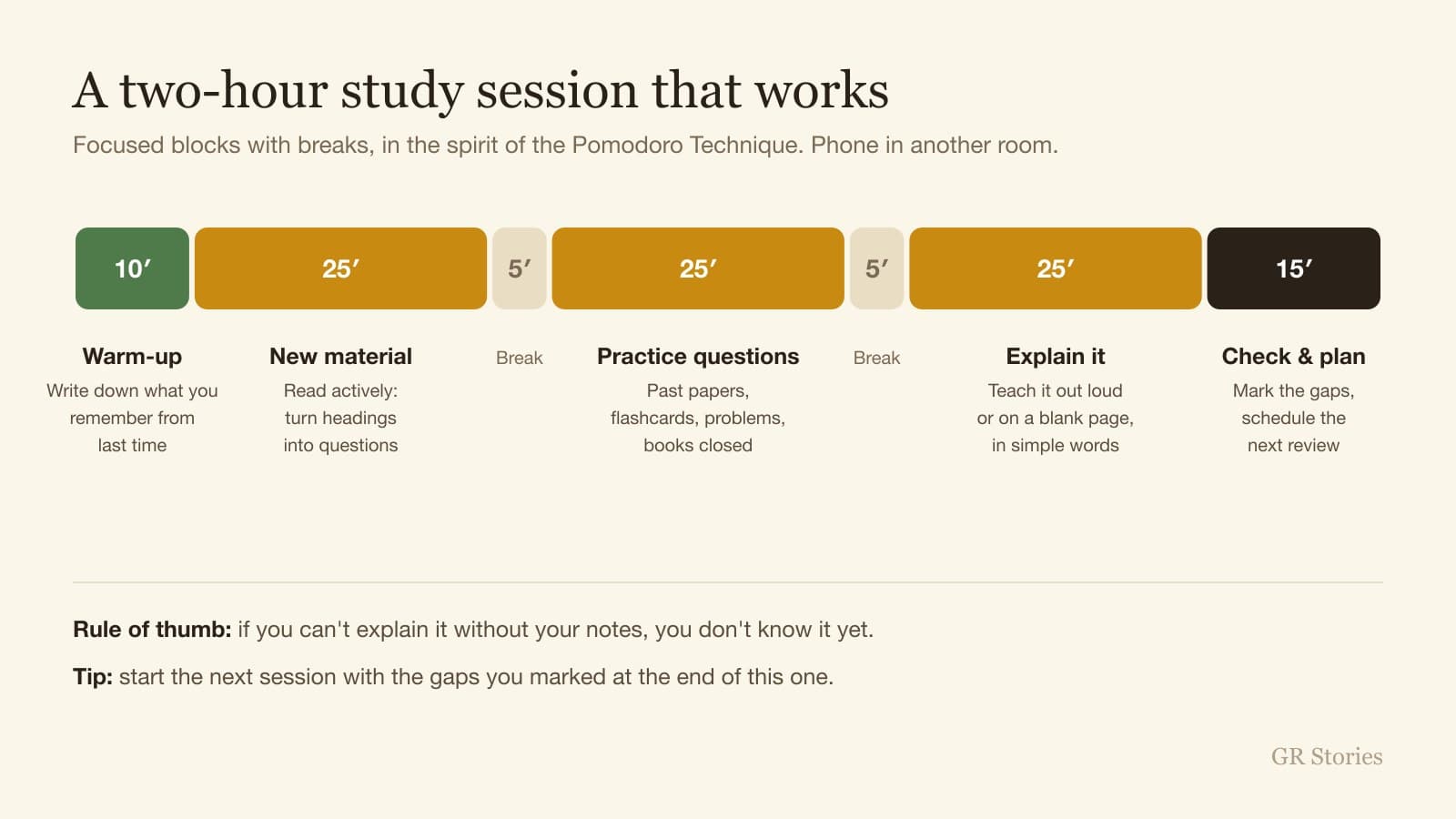
A few things that make the blocks work:
- Put your phone in another room, not face down on the desk. Even a silent phone within reach pulls at your attention.
- Decide the task before the timer starts. "Do the 2022 past paper, questions 1 to 4" works. "Study economics" does not.
- Start with recall. Open each session by writing down what you remember from the last one, then finish by noting the gaps and when you will review them.
- Take real breaks. Walk, stretch, get water or make a coffee. Scrolling social media is not a break for your brain.
6. Plan Backwards From the Exam
Good methods only work if there is time to use them, and that means planning. Open your calendar, mark every exam and deadline of the semester, and work backwards.
- List the topics for each exam and estimate how much work each one needs. Be honest about the ones you have been avoiding.
- Start reviewing in the first weeks, not the last ones. A short weekly review of each course is the easiest way to build in spacing without thinking about it.
- Leave the final days for practice, not for learning new material. The last week should be past papers, self-testing and fixing gaps.
- Plan for real life. If you are studying abroad, trips, visits from home and the time it takes to settle in will all compete with your study hours. Put them in the calendar too, so they do not eat into revision without you noticing.
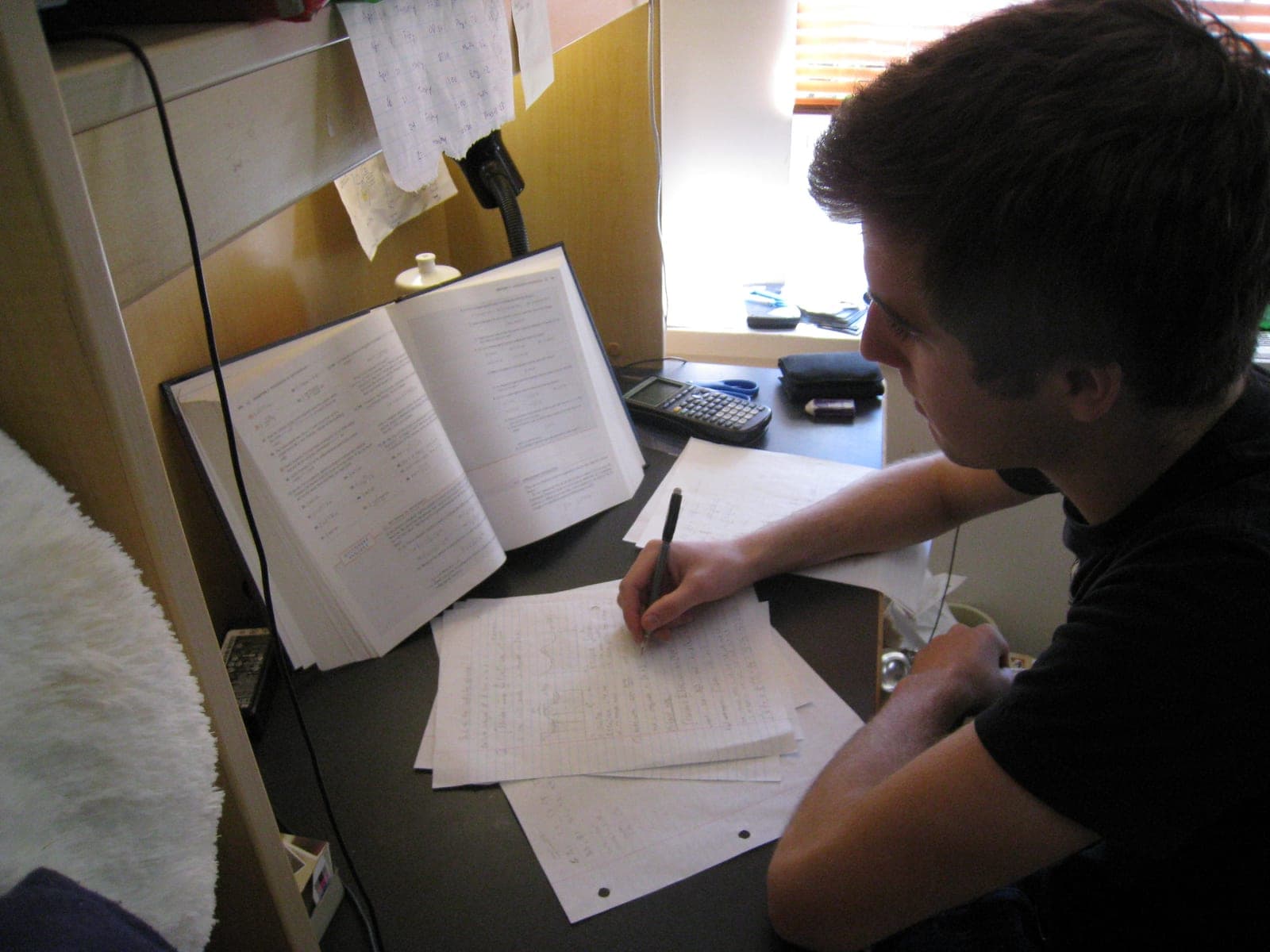
If you need help turning a list of topics into a day-by-day plan, this is another job an AI assistant does well, as long as you give it your real dates, topics and the hours you can actually study.
7. Sleep on It
The all-nighter is a student tradition, and one of the worst trades you can make before an exam. Sleep is not time off from learning: it is when the brain consolidates what you studied during the day, strengthening new memories and linking them to older ones. A major review by Diekelmann and Born (2010) summarises years of evidence that sleep after learning helps memory, while lack of sleep makes it harder both to store new information and to concentrate.
In practice, this means a regular sleep schedule during exam season, revision sessions that end a little before bedtime instead of at 3 a.m., and a decent night's sleep before the exam instead of one last read-through. A proper meal helps as well. If you need something quick and satisfying between study blocks, a real carbonara takes about half an hour.
Common Mistakes to Avoid
- Confusing time spent with progress. Eight hours of rereading can be worth less than two hours of self-testing. Measure what you can recall, not how long you sat at the desk.
- Making beautiful notes and never using them. Rewriting notes neatly feels productive but is mostly copying. Use the time to quiz yourself on them instead.
- Only studying what you already know. It feels good to review your favourite topics. The marks are in the ones you avoid.
- Leaving past papers until the end. Try one early in the semester. It shows you what the exam really asks for and how your professor phrases questions.
- Studying alone when you are stuck. A study group where people explain topics to each other and test each other is practice testing and self-explanation at the same time. A group where you just reread notes together is not.
Studying in a Second Language
If you are studying abroad in a language that is not your first, all of the above still applies, with a few additions. Build a glossary of the key terms for each course in both languages, and test yourself on it like any other flashcards. Practise explaining concepts out loud in the language of the exam, not just reading about them, especially if you have oral exams. And do not be afraid to ask professors whether you can use a dictionary or how they assess international students: the rules differ a lot between countries and universities. If you are still preparing to leave, our semester abroad packing list covers the practical side.
The Bottom Line
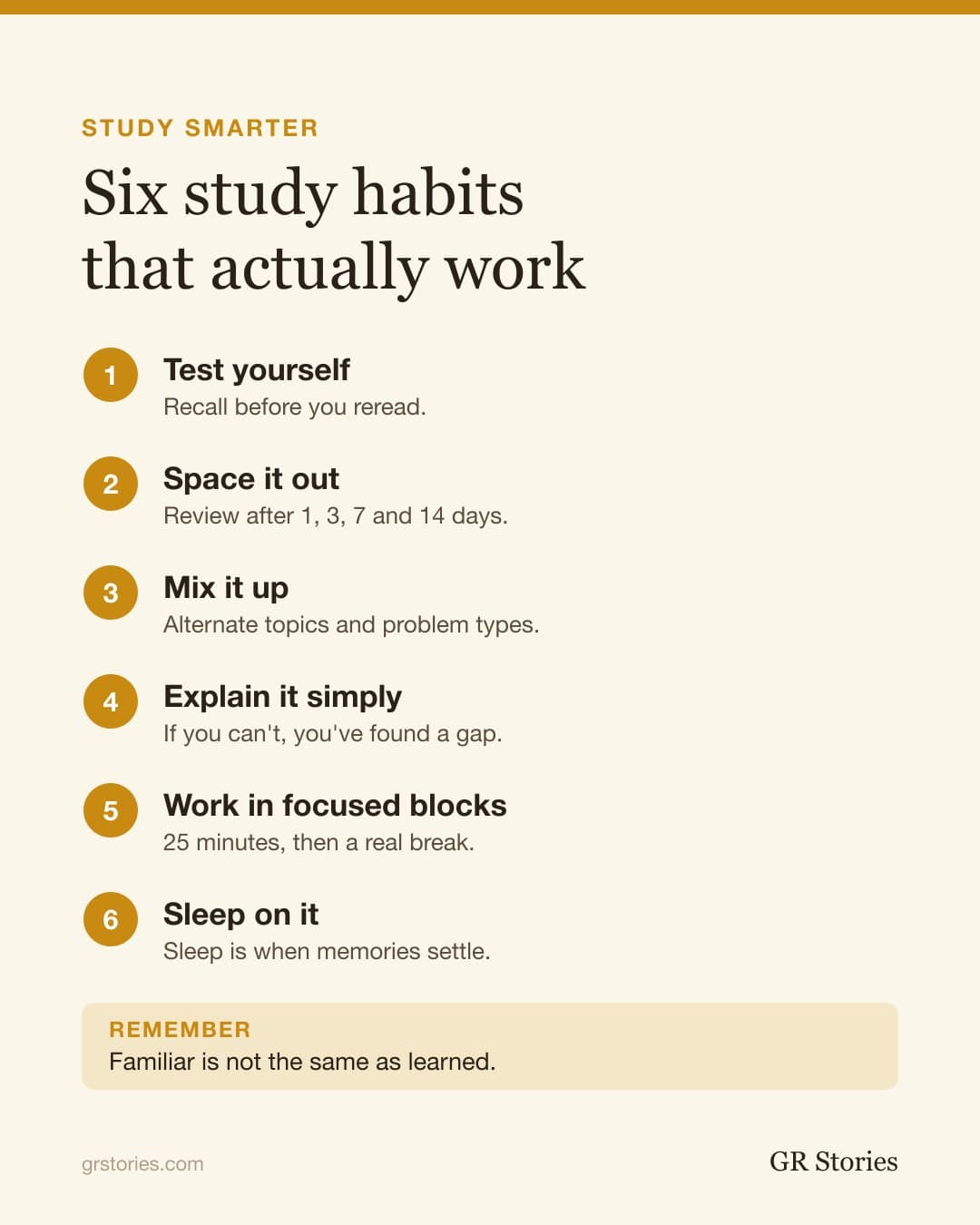
Studying smarter does not mean studying less. It means spending your hours on the things that actually build memory and understanding: pulling information out of your head instead of pouring it in again, spreading reviews over weeks, mixing problems, explaining ideas in your own words, protecting your focus and sleeping enough.
None of it requires an app subscription or a special talent. It does require accepting that the method that feels hardest in the moment is usually the one that works. Start with one change this week, for example closing the book and writing down what you remember, and build from there.
Sources and Photo Credits
- Dunlosky, J., Rawson, K. A., Marsh, E. J., Nathan, M. J. and Willingham, D. T. (2013). Improving Students' Learning With Effective Learning Techniques. Psychological Science in the Public Interest.
- Roediger, H. L. and Karpicke, J. D. (2006). Test-Enhanced Learning. Psychological Science.
- Cepeda, N. J., Vul, E., Rohrer, D., Wixted, J. T. and Pashler, H. (2008). Spacing Effects in Learning. Psychological Science.
- Diekelmann, S. and Born, J. (2010). The Memory Function of Sleep. Nature Reviews Neuroscience.
- Cover photo: students studying in the Sias University library, by Gary Todd, CC0, via Wikimedia Commons.
- Writing notes: photo by Tookapic, CC0, via Wikimedia Commons.
- Student at a desk: photo by Gnarlycraig, public domain, via Wikimedia Commons.
- Charts, session plan and summary card: original graphics by GR Stories.