For many students, the first oral exam at university is a small shock. There is no exam hall, no time to think in silence and no chance to cross out a sentence and start again. There is a desk, a professor (sometimes two), and a question you have to answer out loud, right now, while someone watches you think.
In some countries oral exams are rare. In others, like Italy, they are a normal part of almost every degree, and in much of Europe you will meet them sooner or later: a mündliche Prüfung in Germany, a final oral in a language course, a presentation with questions, a thesis defence. If you are going on exchange, it is quite possible that your first one will be abroad, in a language that is not your own.
The good news is that oral exams reward a kind of preparation that anyone can learn. Knowing the material is the starting point, but it is not enough. You also need to practise saying it.

Why Oral Exams Feel So Different
A written exam tests what you can produce on your own. An oral exam is a conversation, and that changes three things.
There is no hiding. In a written answer you can skip a weak point and spend more words on what you know. In an oral exam, the professor decides where to go next, and a good examiner will follow the weak point.
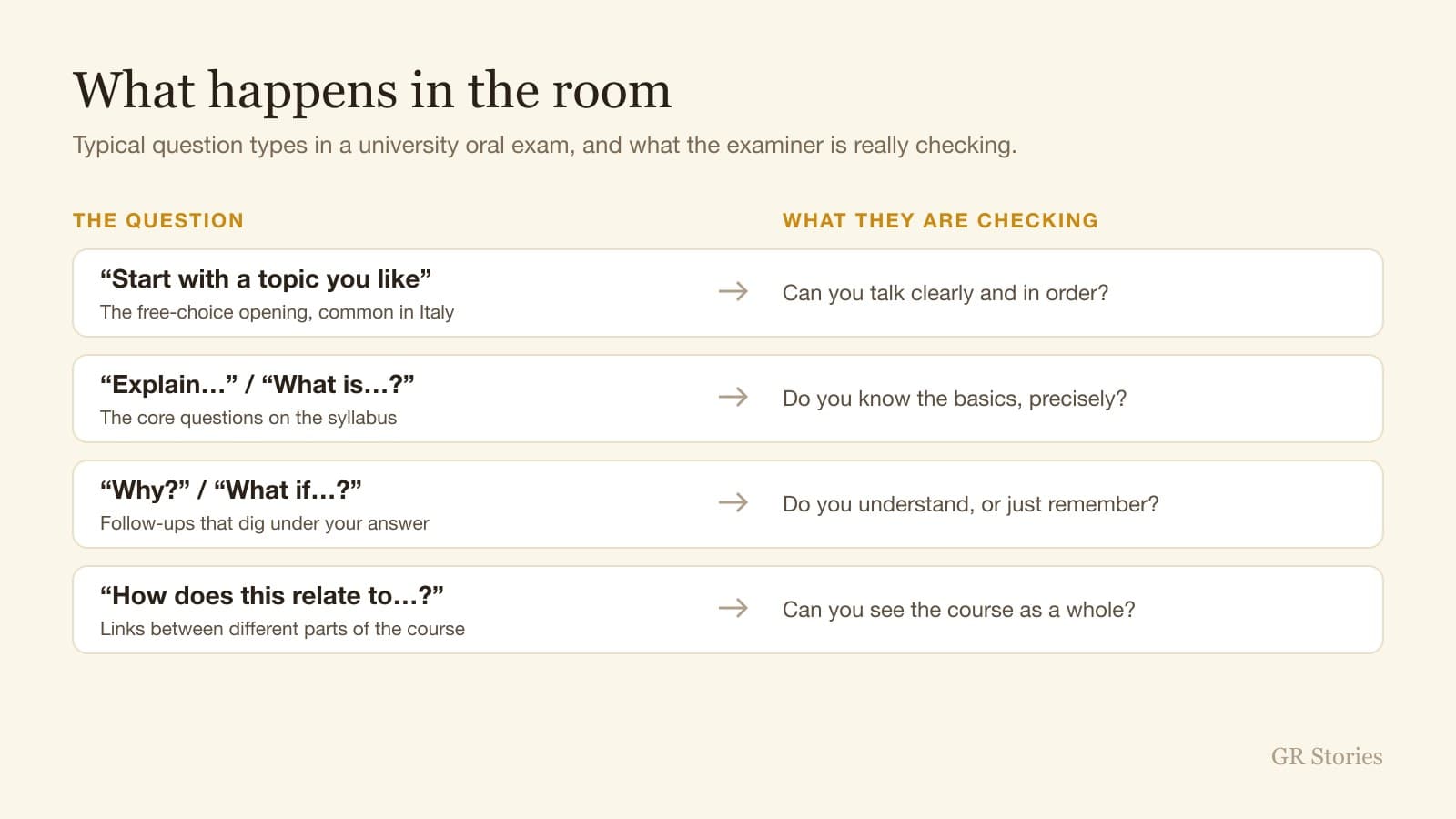
The follow-up questions matter more than the first one. Your first answer shows whether you studied. The "why?", "what if…?" and "how does this connect to…?" that come after it show whether you understood.
How you say it counts. Not your accent or how elegant your sentences are, but whether your answer has an order, whether you use the right terms and whether you can stay calm when you are unsure. Professors are human: a clear, structured answer simply comes across as more convincing than the same content delivered in a panic.
1. Find Out How Your Exam Works
Oral exams vary a lot between countries, universities and even professors in the same department, so start by collecting information.
- Format and length. Is it ten minutes or forty? One examiner or a panel? Do you start with a topic of your choice, or does the professor pick?
- What counts. Is the oral the whole grade, or does it come after a written part? At many Italian universities, for example, the oral can raise or lower the mark you got in the written test.
- The rules on grades. In some systems you can turn down a mark and try again at the next exam session. Know your options before you walk in, so you can decide calmly.
- What the professor likes. Older students are the best source here. Which topics come up every time? Does the professor want formulas, dates, definitions, or the big picture?
If oral exams at your university are public, as they often are in Italy, go and listen to a few before your own. Twenty minutes of watching other students is the best preview you can get of the questions, the pace and the examiner's style.
2. Turn the Syllabus Into a List of Questions
Most students prepare for an oral exam the same way they prepare for a written one: they read the material. But the exam will not ask you to read. It will ask you questions.
So write them down. Go through the syllabus and your notes and turn every topic into the questions you could be asked: "What is…?", "Explain how…", "What is the difference between… and…?", "Why does…?". Add the questions older students remember and anything the professor kept repeating in class.
By the end you will have a list that is effectively your exam. Every study session from now on is about answering those questions, out loud, without notes.
3. Practise Out Loud, Every Day
This is the step most people skip, and the one that makes the biggest difference.
Reading your notes silently and thinking "yes, I know this" is not the same as explaining it. When you try to say it, you discover the gaps: the step you cannot quite explain, the term you cannot remember, the sentence that falls apart halfway through. Much better to discover them at your desk than in front of the professor.
Speaking also helps memory. Psychologists call it the production effect: in experiments by MacLeod and colleagues (2010), people remembered words they had read aloud better than words they had read silently. On top of that, answering a question without looking at your notes is retrieval practice, the most effective study method there is. We explain why in our guide on how to study smarter at university.
How to do it:
- Pick a question from your list, close your notes and answer it out loud, as if the professor were in front of you. Then check what you missed.
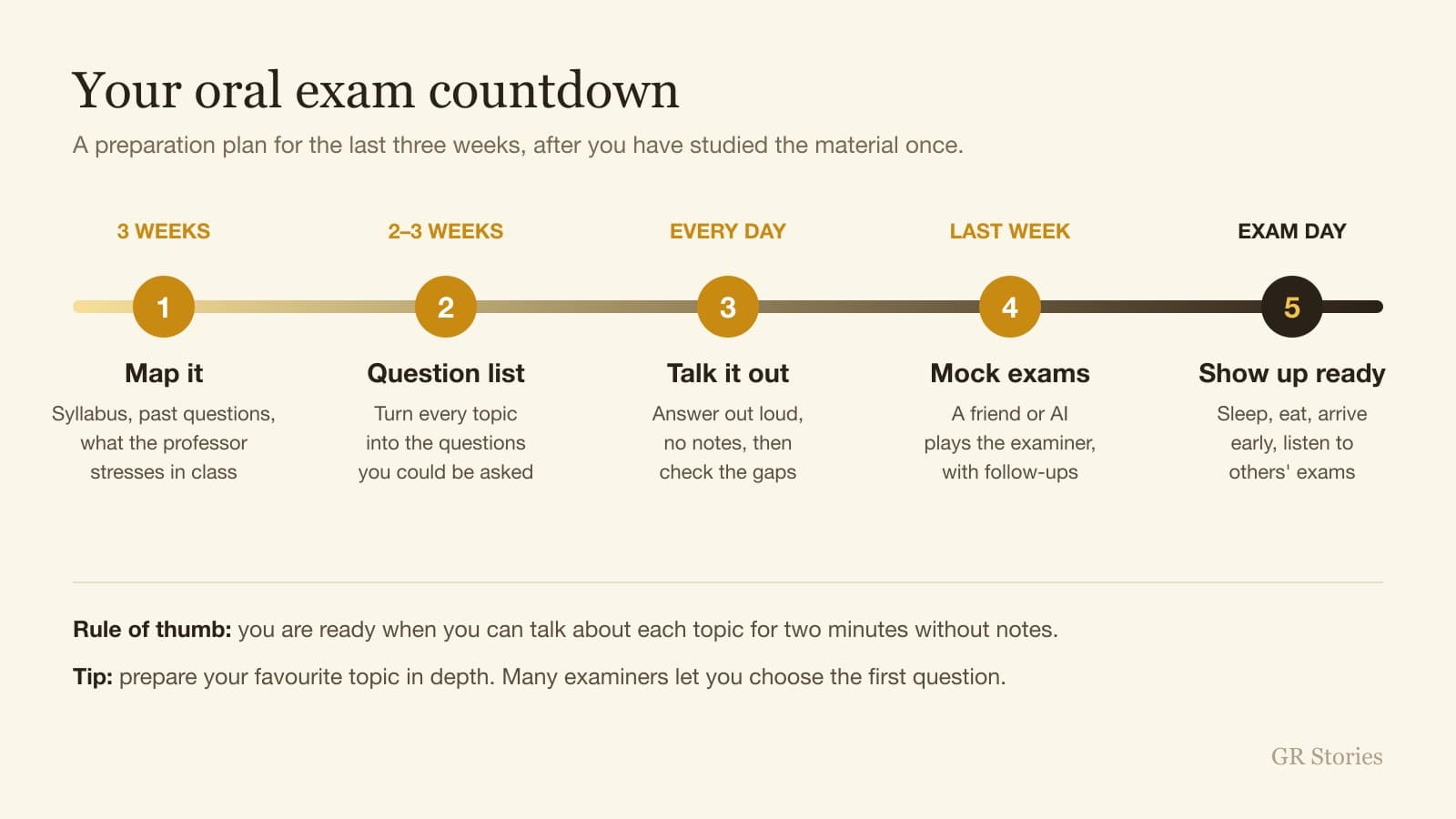
- Time yourself. If you can talk about a topic for two minutes, clearly and without notes, you know it well enough for most oral exams.
- Record yourself once or twice. It is uncomfortable, but you will immediately hear the filler words, the rushing and the answers with no structure.
- Practise in the language of the exam. If you study abroad, this matters even more: knowing a concept in your own language does not mean you can explain it in another.
4. Use a Structure for Every Answer
When you are nervous, the hardest part of an answer is the beginning. A simple structure solves that, because you always know what comes first and what comes next.
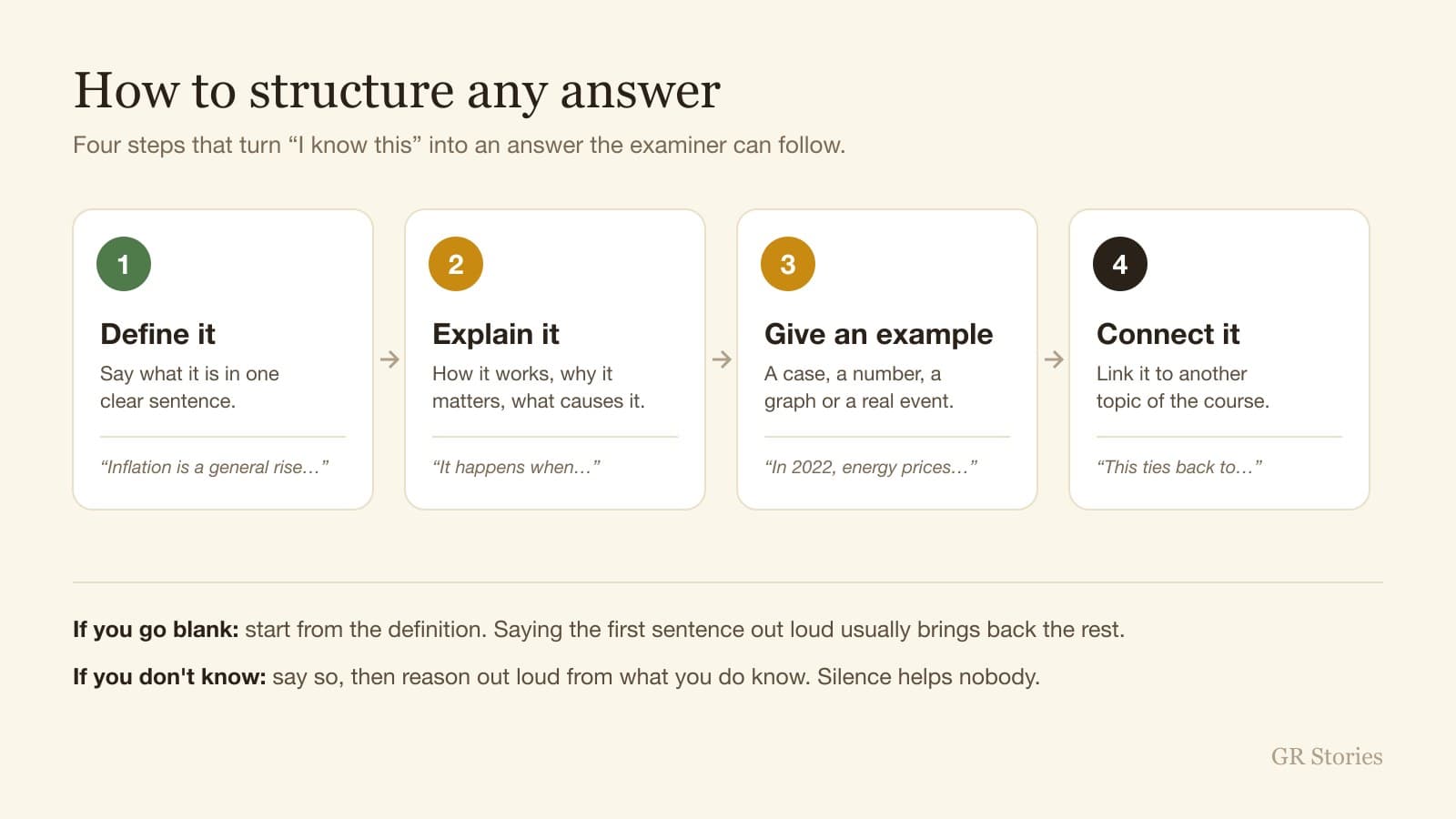
- Define it. Start with one clear sentence saying what the thing is.
- Explain it. How it works, what causes it, why it matters.
- Give an example. A case, a number, a graph you can sketch, a real event. Examples show that you understand, not just remember.
- Connect it. Link it to another part of the course. This is often where the next question comes from, so you are guiding the conversation towards something you know.
Keep your answers reasonably short and then stop. A clear two-minute answer followed by a follow-up question is better than a ten-minute monologue the professor has to interrupt.
5. Simulate the Real Exam
In the last week, stop studying alone and start being examined.
Ask a friend, a classmate or a family member to take your list of questions and play the professor. They do not need to understand the subject. Their job is to ask the question, let you answer and then ask "why?" or "can you give me an example?". Swap roles with a classmate and you will both learn from hearing the other person's answers.
An AI chatbot can also play the examiner surprisingly well, especially for follow-up questions. Give it the topics of your exam and ask it to question you one topic at a time, to wait for your answer and to tell you what was missing. Our guide on writing the perfect AI prompt has a ready-made prompt for oral exam practice. Just remember to answer out loud before you type, otherwise you are practising writing, not speaking.
6. Prepare Your First Topic in Depth
Many examiners, especially in Italy, start by letting you pick a topic you like. It is a gift: the first minutes set the tone for the whole exam, and you get to choose what they are about.
Choose a topic that is important in the course (not a footnote) and that connects to several others, and prepare it better than anything else. Know the definitions perfectly, have an example ready and know where it links to the rest of the programme. A confident start makes you calmer, and it makes a good first impression on the professor.
7. Handle Nerves in the Room
Almost everyone is nervous before an oral exam. The goal is not to feel nothing, but to keep the nerves from taking over.
Reframe the nerves. A racing heart and sweaty hands feel like a sign that something is wrong, but they are your body getting ready to perform. Research backs this up. In a study by Jamieson and colleagues (2010), students who were told that this kind of arousal can improve performance did better on the maths section of a standardised test. In experiments by Brooks (2014), people who told themselves "I am excited" before public speaking performed better than those who tried to calm down. You do not have to feel calm. "I'm excited, I'm ready for this" works better.
Take your time. A pause of a few seconds before answering feels endless to you and perfectly normal to the professor. Use it to pick your first sentence, the definition, and the rest will follow.
Ask if you don't understand. "Do you mean… or…?" is a perfectly good answer to an unclear question, and much better than answering a different question.
Say "I don't know" well. Everyone hits a question they cannot answer. Do not invent and do not freeze. Say honestly that you are not sure, then reason out loud from what you do know: "I don't remember the exact figure, but I know that…". Professors want to see how you think, and showing your reasoning often earns more than a half-remembered fact.
Correct yourself. If you notice a mistake, just say "sorry, let me correct that" and fix it. It shows that you understand the material, not that you are weak.
The Day Before and the Day Itself
- Do not learn anything new the day before. Go through your question list one last time, practise your first topic, then stop. Sleep will do more for your memory than another night with your notes.
- Eat something, and arrive early. Oral exams often run late, and you may wait for hours. Bring water, a snack and something to review lightly, like your list of questions, not the whole textbook.
- Listen to the students before you, if the exam is public. You will hear which questions come up and get used to the room.
- Bring what you need: ID, your student card, any documents your university requires and, for some subjects, paper to sketch a graph or formula.
- Dress normally but tidily. You are not going to a job interview, but looking put together helps you feel ready.

If Your Exam Is in Another Language
Oral exams in a foreign language are more demanding, but professors usually know when they are examining an international student, and many are generous about language as long as the content is right. Speak slowly and clearly rather than quickly with mistakes. Learn the key terms of the course precisely, because using the right technical word matters more than perfect grammar. Prepare a couple of phrases for the difficult moments, such as asking the professor to repeat a question or saying you need a moment to think. And if you are allowed to choose, do not be afraid to ask whether part of the exam can be done in English, as some universities allow it for exchange students. Living abroad is full of moments like this, as we wrote in 3 unexpected things about European universities.
The Bottom Line
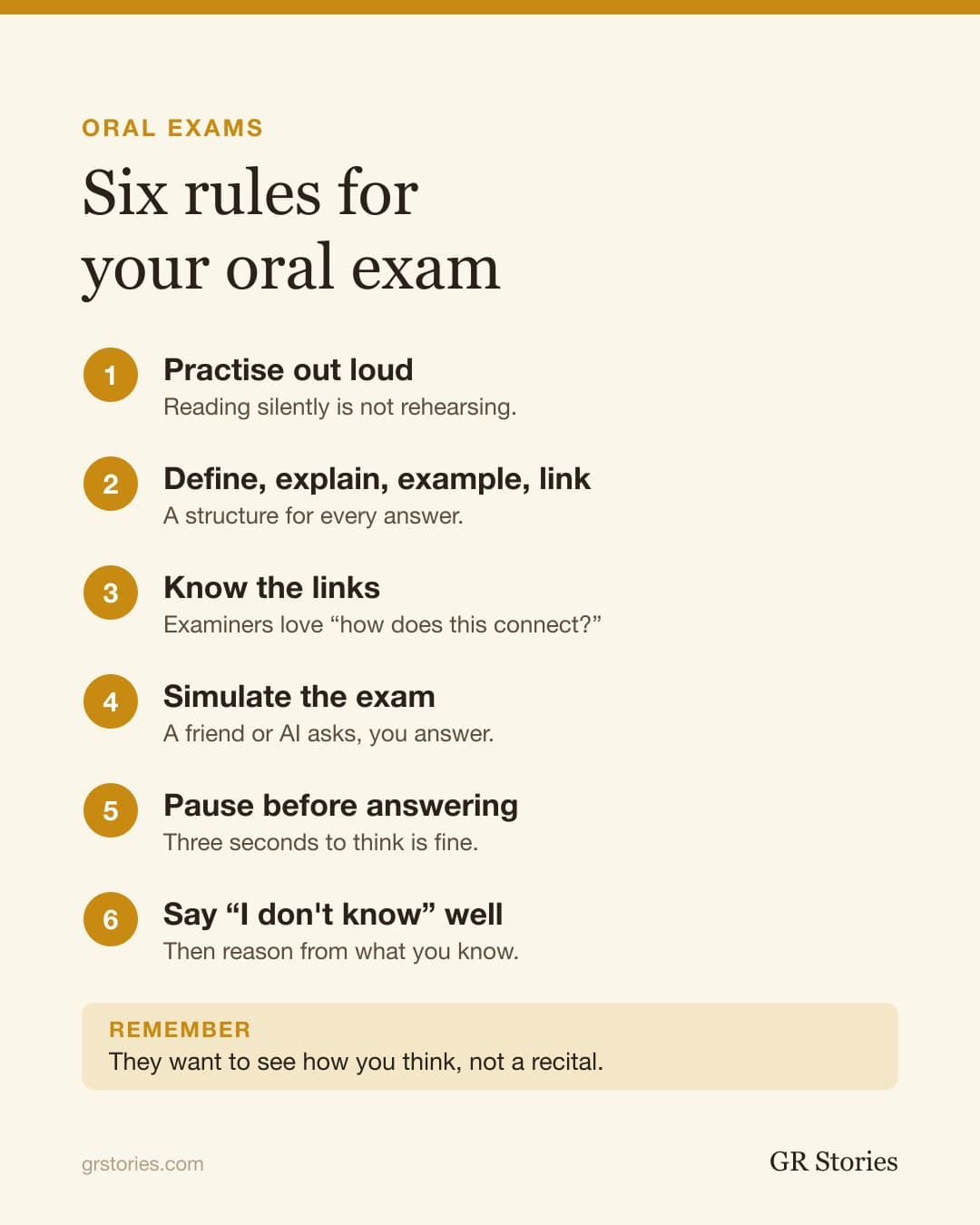
An oral exam is not a recital and not an interrogation. It is a conversation in which the professor wants to see how well you understand the subject and how you think. The students who do well are rarely the ones who studied the most hours: they are the ones who practised saying it.
So find out how your exam works, turn the syllabus into questions, answer them out loud every day, give every answer a structure, get someone to examine you before the real thing, and walk in with your first topic ready. The nerves will probably still be there, and that is fine. Use them.
Sources and Photo Credits
- MacLeod, C. M., Gopie, N., Hourihan, K. L., Neary, K. R. and Ozubko, J. D. (2010). The Production Effect: Delineation of a Phenomenon. Journal of Experimental Psychology: Learning, Memory, and Cognition.
- Jamieson, J. P., Mendes, W. B., Blackstock, E. and Schmader, T. (2010). Turning the Knots in Your Stomach Into Bows: Reappraising Arousal Improves Performance on the GRE. Journal of Experimental Social Psychology.
- Brooks, A. W. (2014). Get Excited: Reappraising Pre-Performance Anxiety as Excitement. Journal of Experimental Psychology: General.
- Cover photo: an open notebook and pencil next to a coffee, by Hope House Press, CC0, via Wikimedia Commons.
- Student speaking: photo by Sikjunior, CC0, via Wikimedia Commons.
- Notebooks and coffee: photo by Freddy Castro, CC0, via Wikimedia Commons.
- Question table, answer structure, preparation countdown and summary card: original graphics by GR Stories.