
For most students in England, the two years between 16 and 18 come down to three letters on a results slip. A levels are the qualification that the majority of British universities are built around, and every year they are studied by students all over the world, from British international schools to sixth-form colleges in London.
They look simple: you choose a few subjects, study them for two years and sit the exams. But the details matter, especially if you come from a system like the IB or the Italian liceo, where you study many subjects at once. How many A levels do you need? What does an A* mean? What changed with the reforms, and how do UCAS points work?
This guide answers those questions using the official explanations from Ofqual, the regulator for qualifications in England, and from UCAS, the service through which students apply to UK universities.

What A Levels Are
A levels, short for Advanced Level qualifications, are subject-based qualifications usually taken between the ages of 16 and 18, in years 12 and 13 of the English school system. They are Level 3 qualifications, the level that UK universities expect for entry.
Unlike the IB, there is no fixed programme. You choose your subjects, and most students take three, sometimes four. There are no compulsory subjects: you could take maths, physics and chemistry, or history, English literature and French, or any combination your school offers. This freedom is the great strength of A levels, and also their risk: the subjects you choose at 16 can open or close doors to university courses.
The exams are set and marked by exam boards, such as AQA, Pearson Edexcel and OCR, and regulated by Ofqual.
Two Years, One Set of Exams
A levels in England were reformed in stages from 2015. Under the government's decision, they became linear: all the exams come at the end of the two-year course, in the summer. Before the reforms, A levels were split into modules taken along the way, and the AS level counted as half of the full A level.
Today the AS is a standalone qualification. It can still be taken, but it no longer counts towards the A level, and many students simply study their A levels for two years without it. The reforms also cut back coursework: Ofqual's rule is that non-exam assessment is used only where the skills cannot be tested properly in an exam, as in art portfolios, the independent investigation in history or the programming project in computer science.
Wales and Northern Ireland have kept their own structures, so the rules differ there; in Scotland, students usually take Highers and Advanced Highers instead.
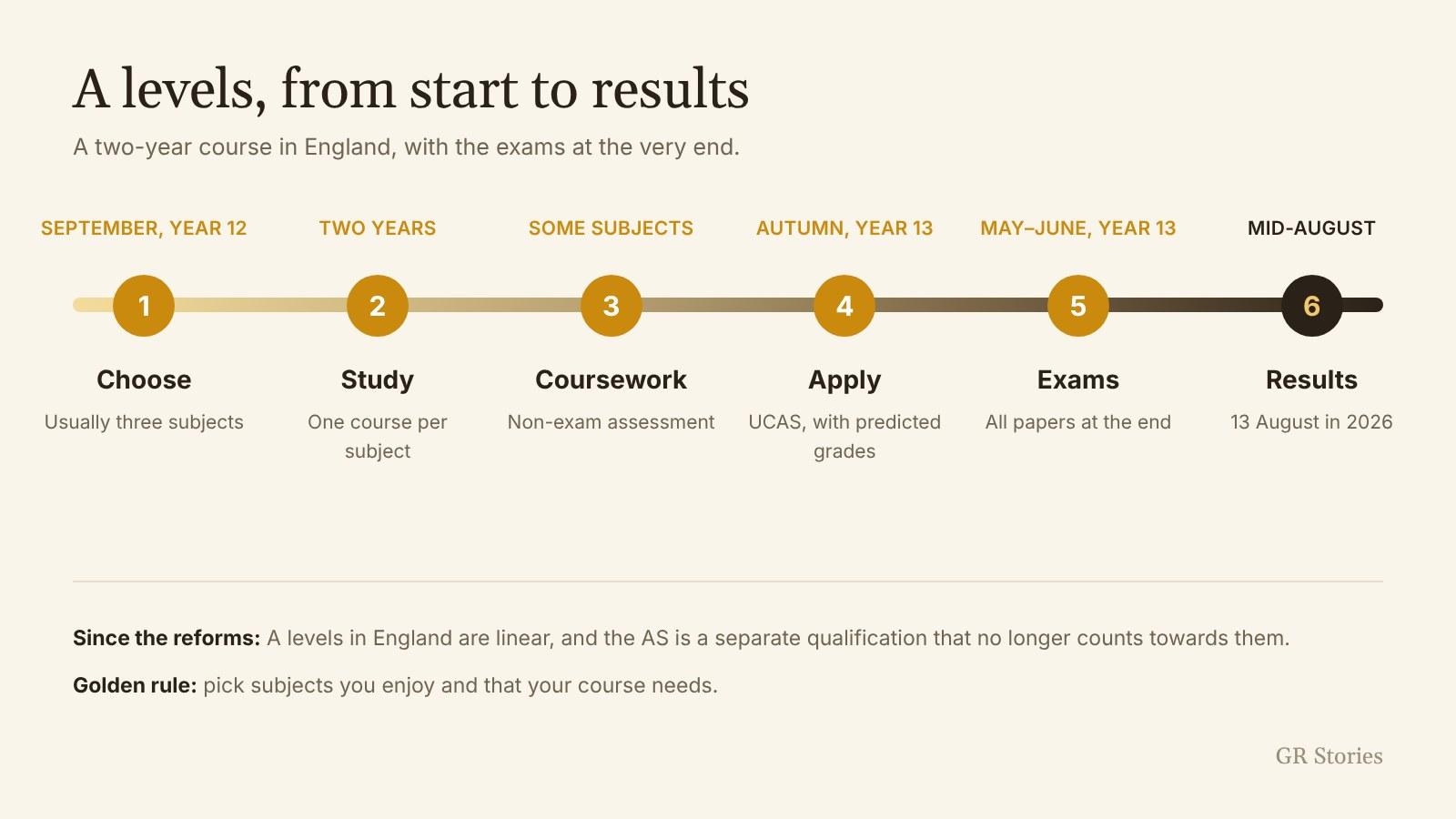
Results arrive on a single day in August, shared by all the exam boards. In 2026, A level results day was Thursday 13 August.
How A Levels Are Graded
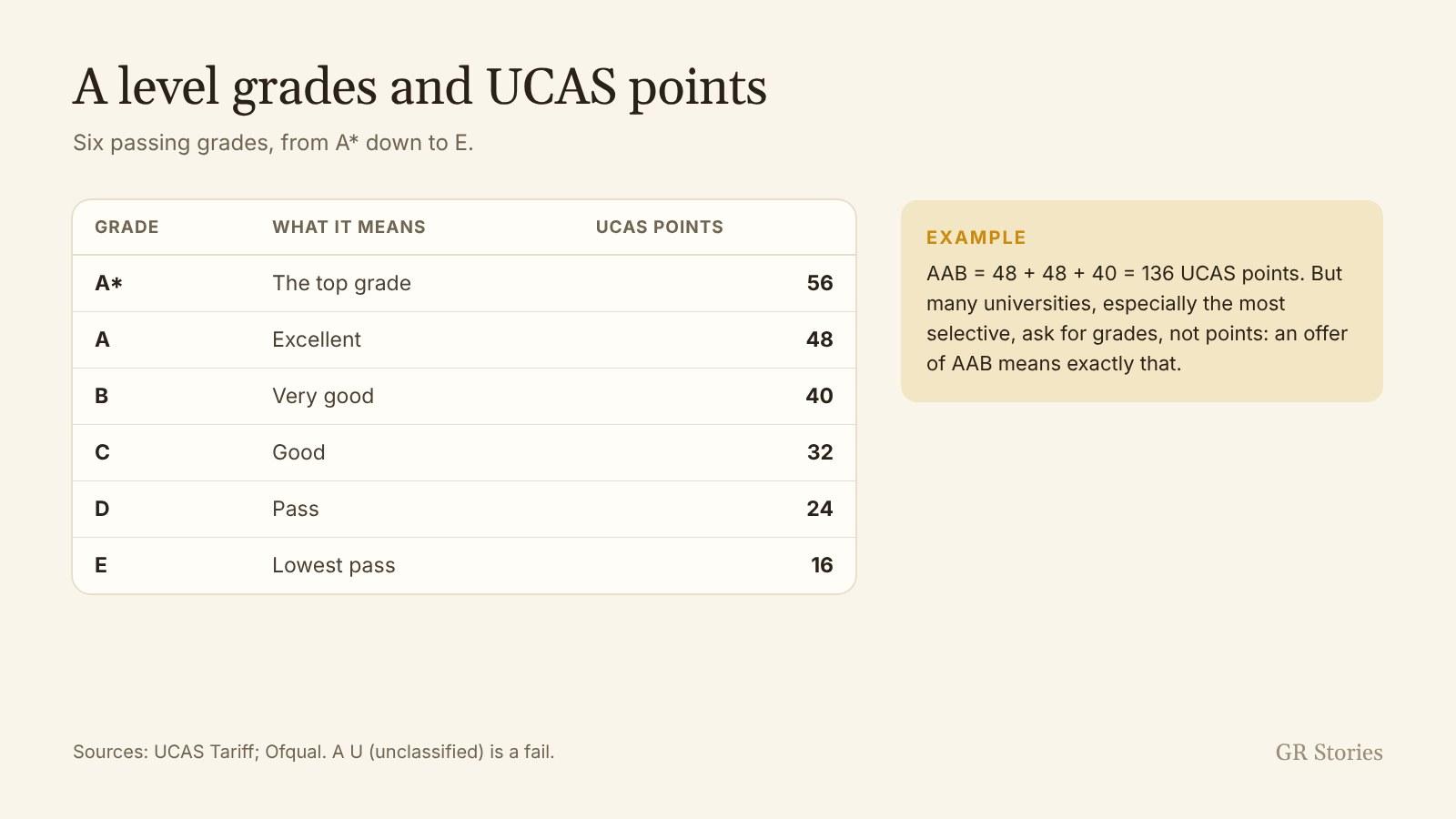
Each A level is graded on a scale of A*, A, B, C, D and E. All of these are passes; a U (unclassified) means a fail. The A*, first awarded in 2010, rewards the very best performances.
University offers are usually written as a string of grades: AAA, A*AA or ABB, for example, sometimes with a specific grade in a named subject, such as "A* in mathematics". Oxford's physics course asks for A*AA, with the A* in physics, mathematics or further mathematics.
UCAS Points
Some universities express their requirements in UCAS Tariff points instead of grades. Each grade has a value: an A* is worth 56 points, an A 48, a B 40, a C 32, a D 24 and an E 16. So AAB adds up to 136 points.
The Tariff exists to help universities compare very different qualifications fairly: an IB Higher Level 7, for example, is also worth 56 points. But UCAS itself warns that universities set their own entry requirements, do not have to use Tariff points, and may only count your best three A levels. The most selective universities almost always ask for grades.
Choosing Your Subjects
The most important A level decision is made before you start: which subjects to take. A few practical rules help:
- Start from the course. Medicine usually requires chemistry, engineering requires maths and often physics, and economics at many universities requires maths. Check two or three courses you like before you choose.
- Pick subjects you enjoy. You will spend two years on them, and you will do better in subjects you like.
- Keep a door open. If you are unsure, a mix that includes maths or a science keeps more courses available.
- Think about the workload. Some subjects have heavy practical or written coursework; ask your teachers what each one involves.
Getting the Most out of Two Years
Because everything depends on the final exams, A levels reward steady revision rather than last-minute cramming. Spread your revision across the two years, practise past papers under timed conditions and learn from the mark schemes, which show exactly what examiners are looking for. Our guide on how to study smarter at university explains methods, such as active recall and spaced repetition, that work just as well for A level revision.
The Bottom Line
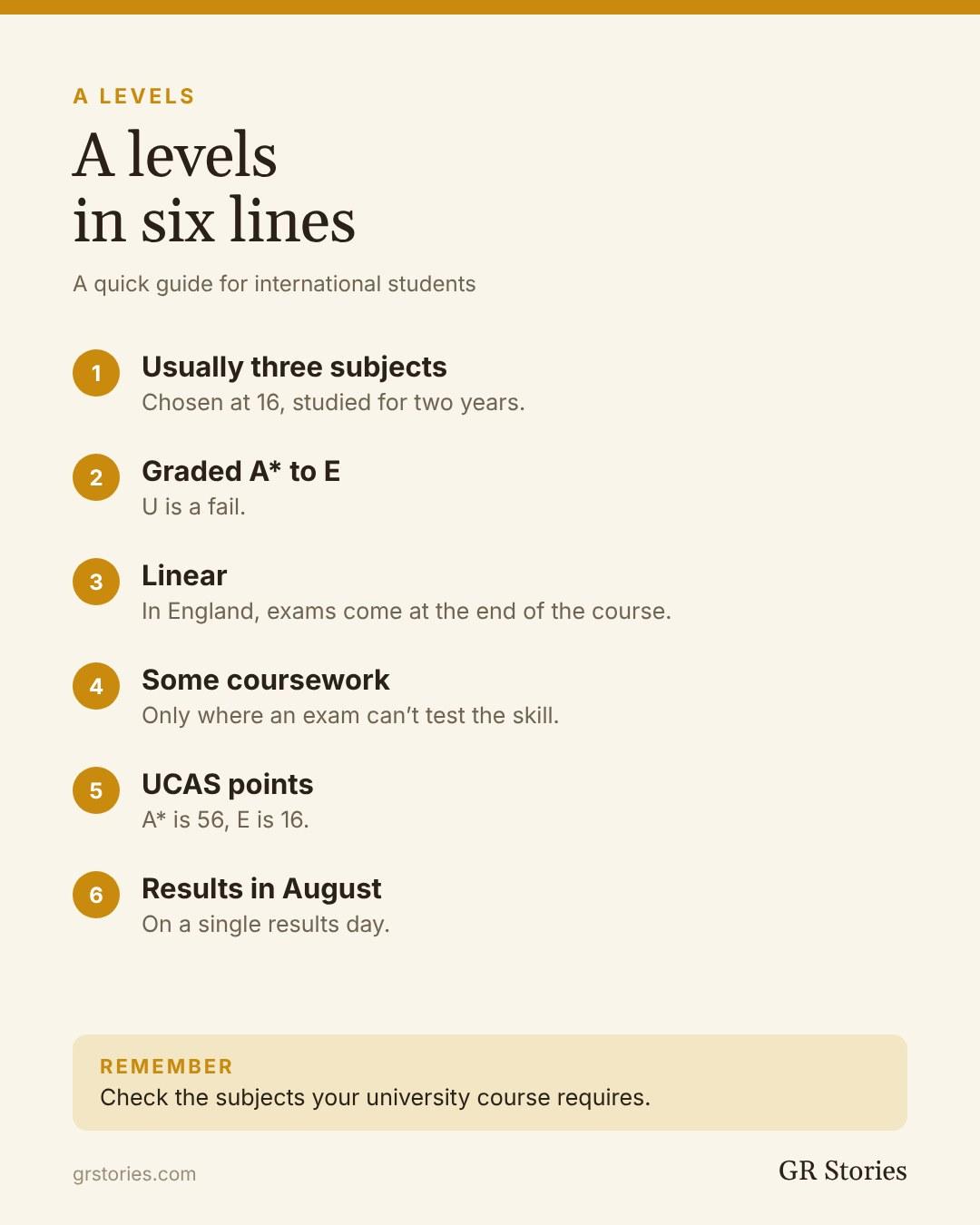
A levels are simple in shape and demanding in depth: usually three subjects, two years, exams at the end and grades from A* to E. The choice of subjects is the decision that matters most, so make it with your future course in mind. And if you are applying to UK universities, you will also need a strong personal statement; if you are applying to the United States as well, our guide on how to prepare for the SAT covers the other side of the Atlantic.
Sources and Photo Credits
- Ofqual and Department for Education, AS and A level changes: a summary and An update from Ofqual on A level reform (linear assessment, AS decoupling, non-exam assessment).
- GOV.UK, What qualification levels mean.
- UCAS, UCAS Tariff calculator (how universities use Tariff points).
- University of Oxford, Department of Physics, How to apply (example offer).
- Cover: Person using pencil by Ben Mullins, Unsplash.
- Library: Person in front of bookshelf by Matthew Feeney, Unsplash.
- Grades table, A level calendar and summary card: original graphics by GR Stories.