
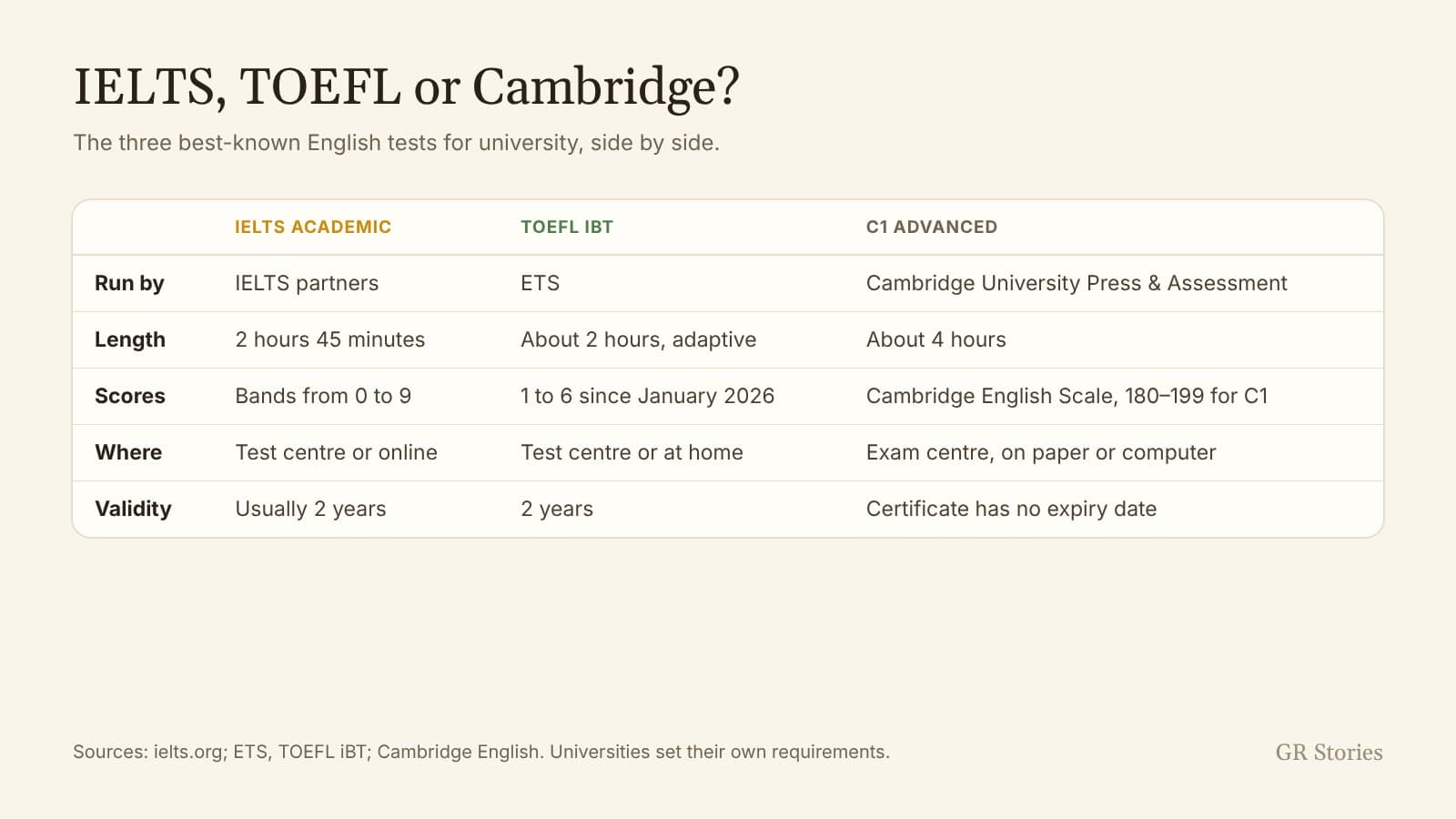
If you want to study in English and it is not your first language, sooner or later a university will ask you for proof. In most cases, that means a score from one of three tests: IELTS, the TOEFL or a Cambridge English exam such as C1 Advanced. Each is respected, each measures the same four skills, reading, listening, writing and speaking, and each has changed recently. Choosing the wrong one can cost time and money.
This guide compares the three, using the official information from the organisations that run them, with the latest changes for 2026.
First, Check What Your University Accepts
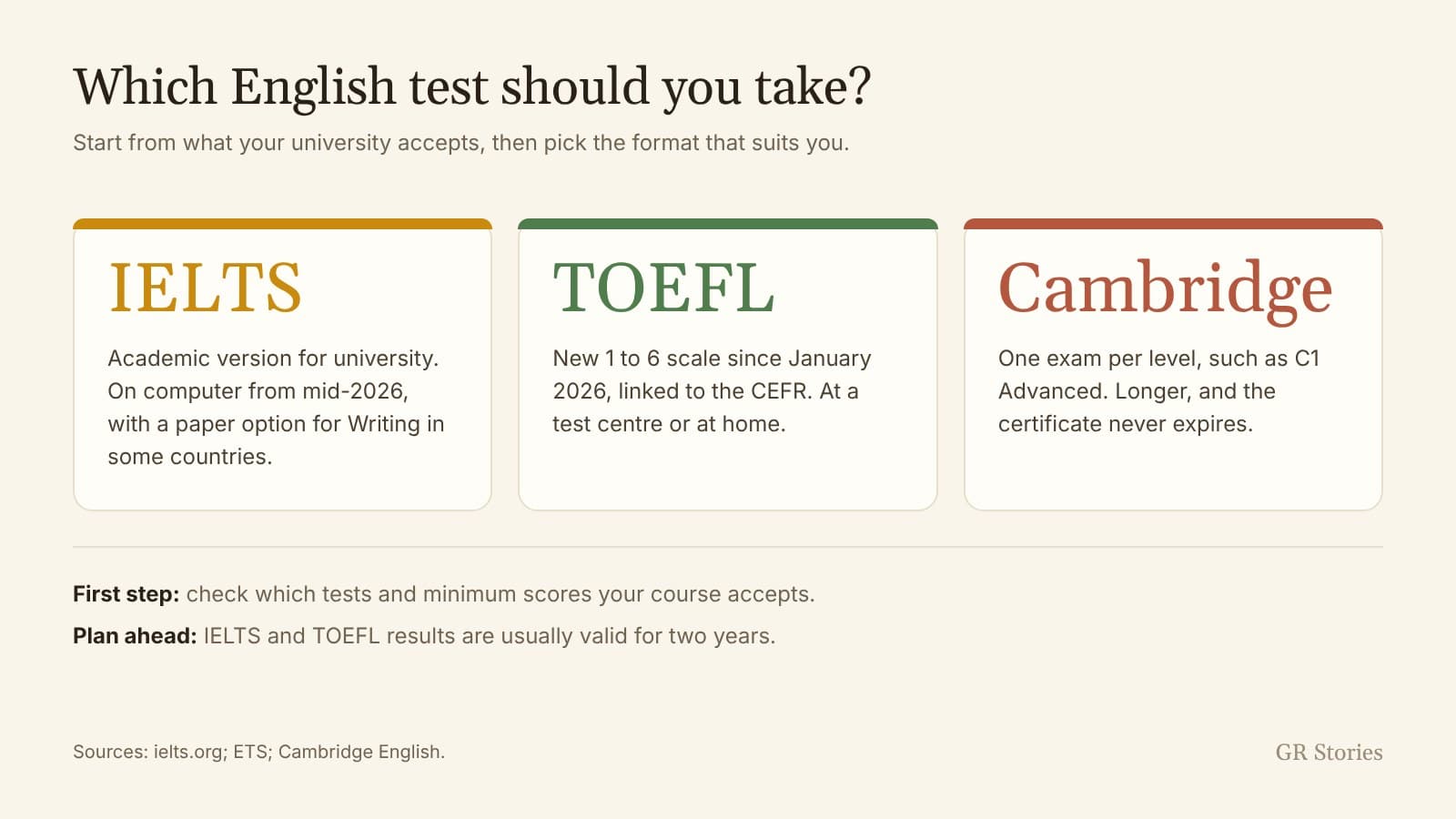
Before you think about which test you prefer, look at the admission page of your course. Universities decide which tests they accept and which scores they require, sometimes with minimums for each skill as well as for the total. ETS, which runs the TOEFL, puts it simply: there are no passing or failing scores, and each institution sets its own requirements.
Check also how recent your result must be, and whether you need the test for a visa as well as for admission. For a UK student visa, for example, there is a specific version of IELTS approved by the UK government.
IELTS
IELTS comes in two main versions. IELTS Academic is the one for university study: it assesses whether you are ready to study in English, with vocabulary from academic settings. IELTS General Training is for migration, work and study below degree level.
IELTS Academic lasts 2 hours and 45 minutes and has four sections:
- Listening: about 30 minutes, 40 questions;
- Reading: 60 minutes, 40 questions;
- Writing: 60 minutes;
- Speaking: 11 to 14 minutes, face to face with an examiner.
Results are reported on a 9-band scale, in whole and half bands, for each skill and overall. IELTS recommends that results are considered valid for two years, although universities can accept older ones.
The big change is the format. From mid-2026, IELTS is no longer offered on paper: all tests are on computer, at a test centre or online, with timelines varying by country. In selected markets, you can still choose to handwrite the Writing section on paper. Computer-based IELTS also offers the One Skill Retake, which lets you retake a single section instead of the whole test.
TOEFL iBT
The TOEFL iBT, run by ETS, measures the same four skills, with tasks based on university life: reading academic passages, listening to lectures, writing for an academic discussion, speaking in an interview. It is an adaptive test, so the questions adjust to your level, and ETS advises allowing about two hours. You can take it at a test centre or at home, with the Home Edition, watched by a live human proctor.
The scoring changed on 21 January 2026. Score reports now use a 1 to 6 scale, in half points, for each section and overall, designed to align more closely with the Common European Framework of Reference, the CEFR. The overall score is the average of the four sections, rounded to the nearest half point. For a two-year transition, reports also show a comparable score on the old 0 to 120 scale, and ETS publishes a table comparing the two.
Scores appear in your ETS account three days after the test, they are valid for two years, and the test fee includes up to four free score reports to universities, if you choose them by 10 p.m. on test day.
Cambridge C1 Advanced
Cambridge English Qualifications, from Cambridge University Press & Assessment, work differently: there is one exam for each level of the CEFR, from A2 Key to C2 Proficiency. For university, the most relevant is C1 Advanced, which Cambridge says is accepted by more than 11,000 educational institutions, businesses and government departments.
C1 Advanced has four papers, takes about four hours and can be taken on paper or on computer at an exam centre. Results are reported on the Cambridge English Scale, where 180 to 199 corresponds to C1: 180 to 192 is grade C, 193 to 199 grade B, and 200 to 210 a grade A at C2 level. You receive a score for each skill and an overall result.
A Cambridge certificate has no expiry date, which is a real advantage. But universities are free to ask for a recent result anyway, so check before you rely on an old one.
Which One Should You Take?
There is no best test, only the one that fits your plans:
- If your universities list only one test, take that one.
- If you need a UK student visa, check whether you need IELTS for UKVI.
- If you prefer a computer-based, adaptive test that you can take at home, the TOEFL iBT is designed for that.
- If you want a certificate that does not expire and a single exam aimed at one level, consider C1 Advanced.
- If you are nervous about speaking to a computer, remember that the IELTS Speaking test is a conversation with a real examiner.
Whichever you choose, practise with official sample tests, time yourself, and give the speaking section the same attention as the rest: our guide on how to prepare for an oral exam has techniques that work in any language. And once you are studying in English, our article on what AI can't do when you study in another language explains why real practice still matters.
The Bottom Line
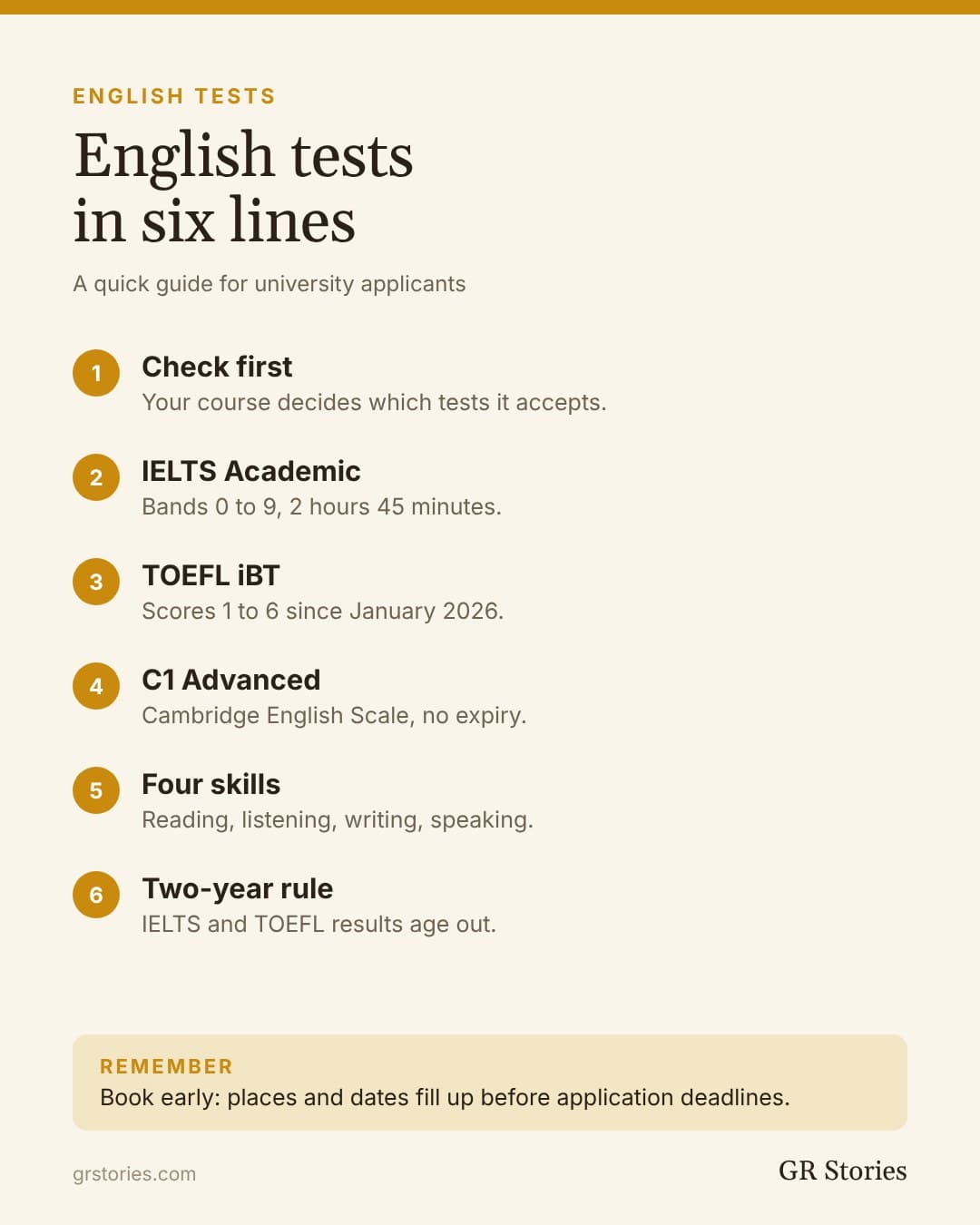
IELTS, the TOEFL and Cambridge C1 Advanced all measure the four skills, and all are widely accepted, but they differ in format, length, scoring and validity. IELTS is now computer-based, the TOEFL has moved to a 1 to 6 scale, and a Cambridge certificate does not expire. Start from your university's requirements, book early, because test dates fill up before application deadlines, and plan for the two-year validity of IELTS and TOEFL results.
Sources and Photo Credits
- IELTS, Test types, IELTS Academic test and IELTS scoring in detail (versions, format, timing, band scale, validity).
- IELTS, Updates to IELTS test delivery (end of the paper-based test from mid-2026, Writing on Paper).
- ETS, TOEFL iBT scores and What's on the test (1 to 6 scale since January 2026, timing, validity, score reports).
- Cambridge English, C1 Advanced and Results (format, Cambridge English Scale, grades).
- Cover: Man wearing headphones in front of a laptop by Wes Hicks, Unsplash.
- Dictionary: Open dictionary by Waldemar Brandt, Unsplash.
- Comparison table, test cards and summary card: original graphics by GR Stories.