At some point around the age of 15 or 16, many students in international and British schools face the same question: IB or A levels? It is one of the most important educational choices you will make, because it shapes the next two years of your life and the subjects you can study at university. And it is often made in a hurry, on the basis of what friends are doing or what a school happens to offer.
The good news is that there is no wrong answer. Both qualifications are respected by universities all over the world, both lead to the most competitive courses, and both can be excellent preparation for higher education. The real question is not which one is better, but which one is better for you.
This guide compares the two, using the official rules of the International Baccalaureate and of Ofqual, the regulator for A levels in England, together with real university entry requirements.
The Basic Difference: Breadth or Depth
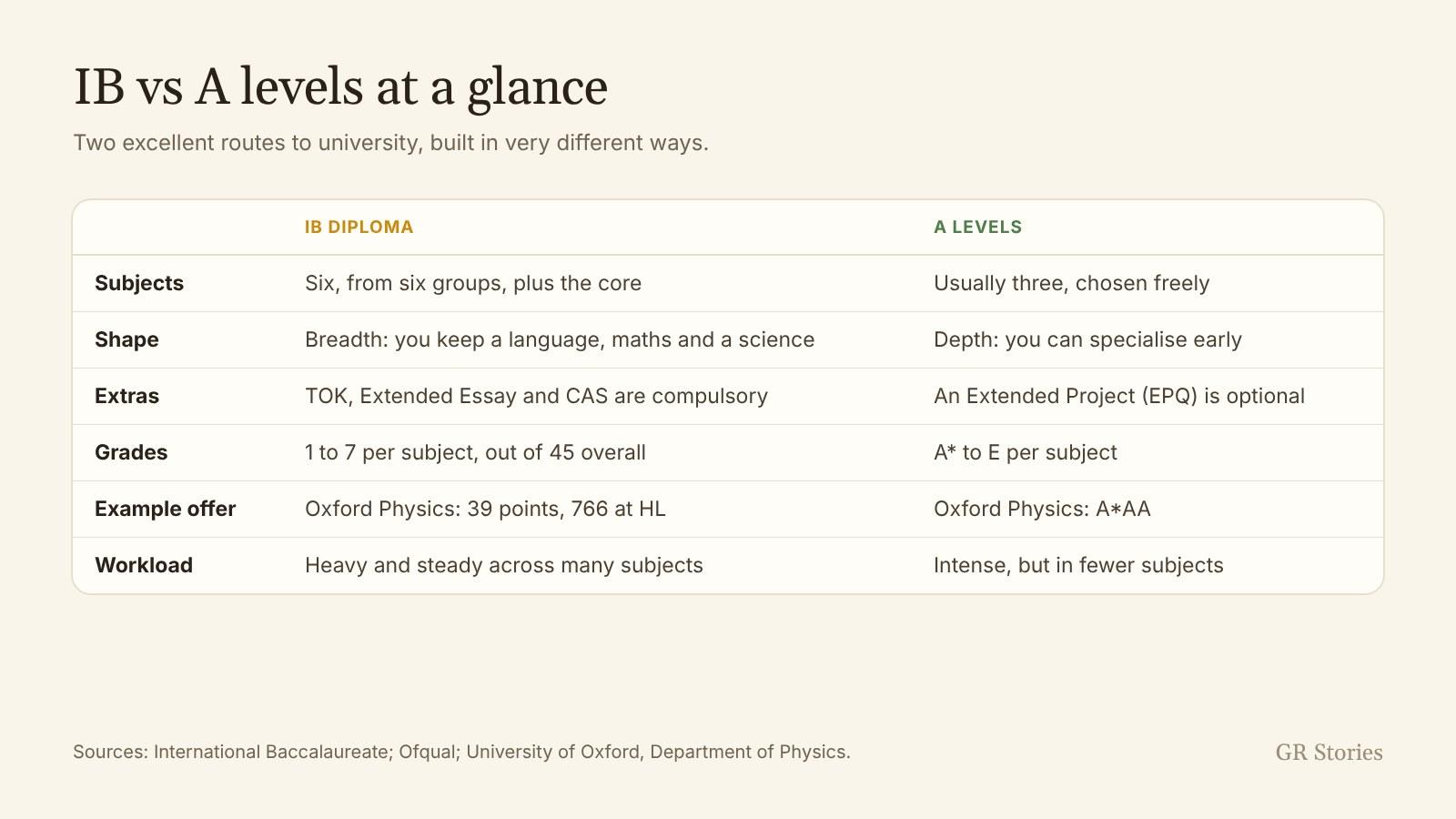
The IB Diploma is a complete programme. You study six subjects, normally one from each of six groups, three or four of them at Higher Level, plus the core: Theory of Knowledge, a 4,000-word Extended Essay and CAS, a programme of creativity, activity and service. You keep a language, maths, a science and a humanity until the very end of school.
A levels are individual qualifications. You usually choose three subjects, with no compulsory ones, and study them in depth for two years. You can specialise completely: maths, further maths and physics, for example, or three humanities.
So the IB is built on breadth, A levels on depth. Everything else follows from that.
How They Are Assessed
In the IB, each subject is graded from 1 to 7, and TOK and the Extended Essay add up to 3 points, for a maximum of 45. Passing requires at least 24 points and a series of other conditions, such as no grade E in TOK or the Extended Essay. Every subject includes coursework marked by teachers and checked by the IB, and most exams take place in May of the final year.
A levels are graded from A* to E in each subject. In England, they are linear: all the exams come at the end of the two years, and coursework, called non-exam assessment, is used only where an exam cannot test the skills properly.
In practice, IB students work steadily on many fronts at once, with internal deadlines throughout the two years. A level students carry fewer subjects, but the final exams weigh more heavily.
What Universities Ask For
Universities make offers in both currencies. Oxford's physics course is a good example: it asks for A*AA at A level, or 39 points in the IB, including the core, with 7, 6 and 6 in the Higher Level subjects. In both cases, the right subjects matter as much as the grades: physics and maths are required either way.
For universities that use UCAS Tariff points, an A* at A level and a 7 at IB Higher Level are both worth 56 points. But many selective universities ignore the Tariff and set grade or points requirements directly, so always check the course page.
Which One Suits You?
Think honestly about how you like to learn. These questions help:
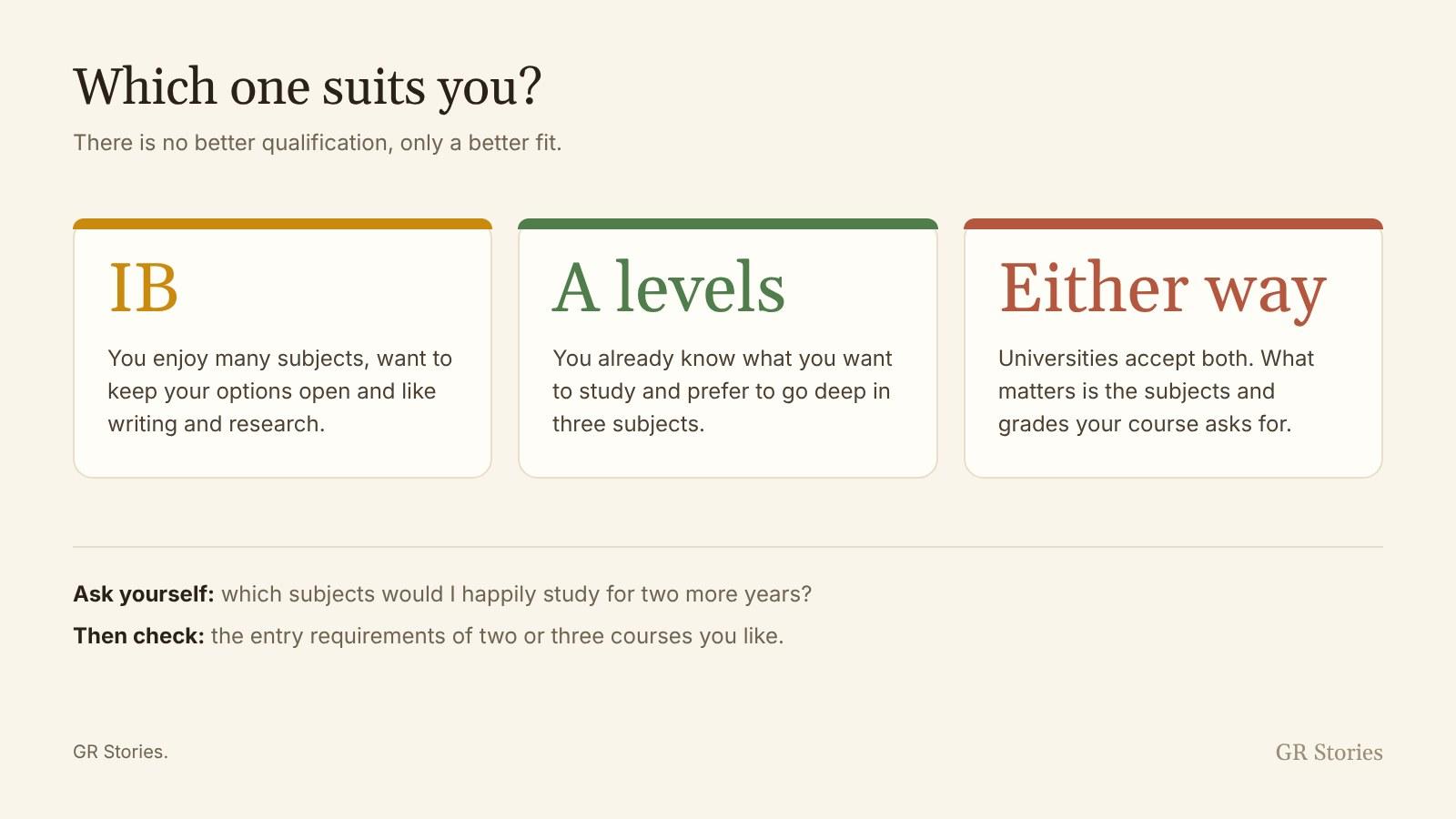
- Do you enjoy many subjects? If giving up languages or a science would feel like a loss, the IB lets you keep them.
- Do you already know what you want to study? If you are sure about medicine, engineering or law, A levels let you focus on the subjects that matter for it.
- How do you handle steady pressure? The IB has deadlines all the way through; A levels concentrate the pressure at the end.
- Do you like writing and research? The Extended Essay and TOK reward curiosity and good writing.
- Where do you want to study? Both work in the UK and in most of Europe. If you want to keep several countries open, the IB's breadth can help, as can its international recognition.
Common Myths
- "The IB is harder." It is broader, and the workload is constant. A levels can be just as demanding in their subjects. Difficulty depends on the student.
- "Universities prefer the IB." They accept both. What they care about is your subjects and your grades.
- "A levels mean you can't keep languages." You can take a language as one of your A levels; you just aren't required to.
- "You need four A levels for top universities." Most offers, including Oxford's for physics, are based on three.
- "The IB is only for international students." Many students in their home country choose it too.
The Bottom Line
The IB gives you breadth, research skills and a structure that keeps doors open; A levels give you depth, freedom and the chance to specialise early. Pick the one that matches how you learn and what you want to study, not the one your friends are choosing. Then make the most of it: our guide on how to study smarter at university works for both, and if you will face oral assessments, as IB students do in languages, our guide on how to prepare for an oral exam will help.
Sources and Photo Credits
- International Baccalaureate, DP passing criteria.
- Ofqual and Department for Education, AS and A level changes: a summary.
- UCAS, UCAS Tariff calculator.
- University of Oxford, Department of Physics, How to apply (A level and IB requirements).
- Cover: Radcliffe Camera in Oxford by Ben Seymour, Unsplash.
- Magdalen College: A green courtyard surrounded by historic stone buildings by Jessica Share, Unsplash.
- Comparison table and "which one suits you" cards: original graphics by GR Stories.