You sit your first exam at an Italian university, wait a few days, log into the student portal and find a number: 24. Is that good? Is it a pass? Should you be pleased, or worried? Your Italian classmates seem to know instantly, and nobody thinks to explain.
Italian universities use a grading system that makes perfect sense once you know it and very little before. Exams are marked out of 30, the pass mark is 18, the best result comes with an extra word, lode, and your final degree is marked out of 110. In between there are credits called CFU, an average that is not quite an average, and the surprising option of saying no to a grade you have just earned.
This guide explains all of it, using the official explanations published by Italian universities themselves. The general rules are national, but details such as thesis points and how a lode counts vary from one university, and even one degree, to another, so always check your own course regulations as well.
Exams Are Marked Out of 30
Every exam at an Italian university is graded on a scale of 30. The minimum passing grade is 18/30, and the maximum is 30/30. When a performance is outstanding, the examining board can add a distinction, the lode, and the grade becomes 30 e lode (30 cum laude), often written as 30L.
Grades below 18 are failing grades, and here is the part that surprises many international students: as Ca' Foscari University of Venice explains, they are not registered. A failed exam does not appear on your transcript at all. You simply take it again at a later exam date.
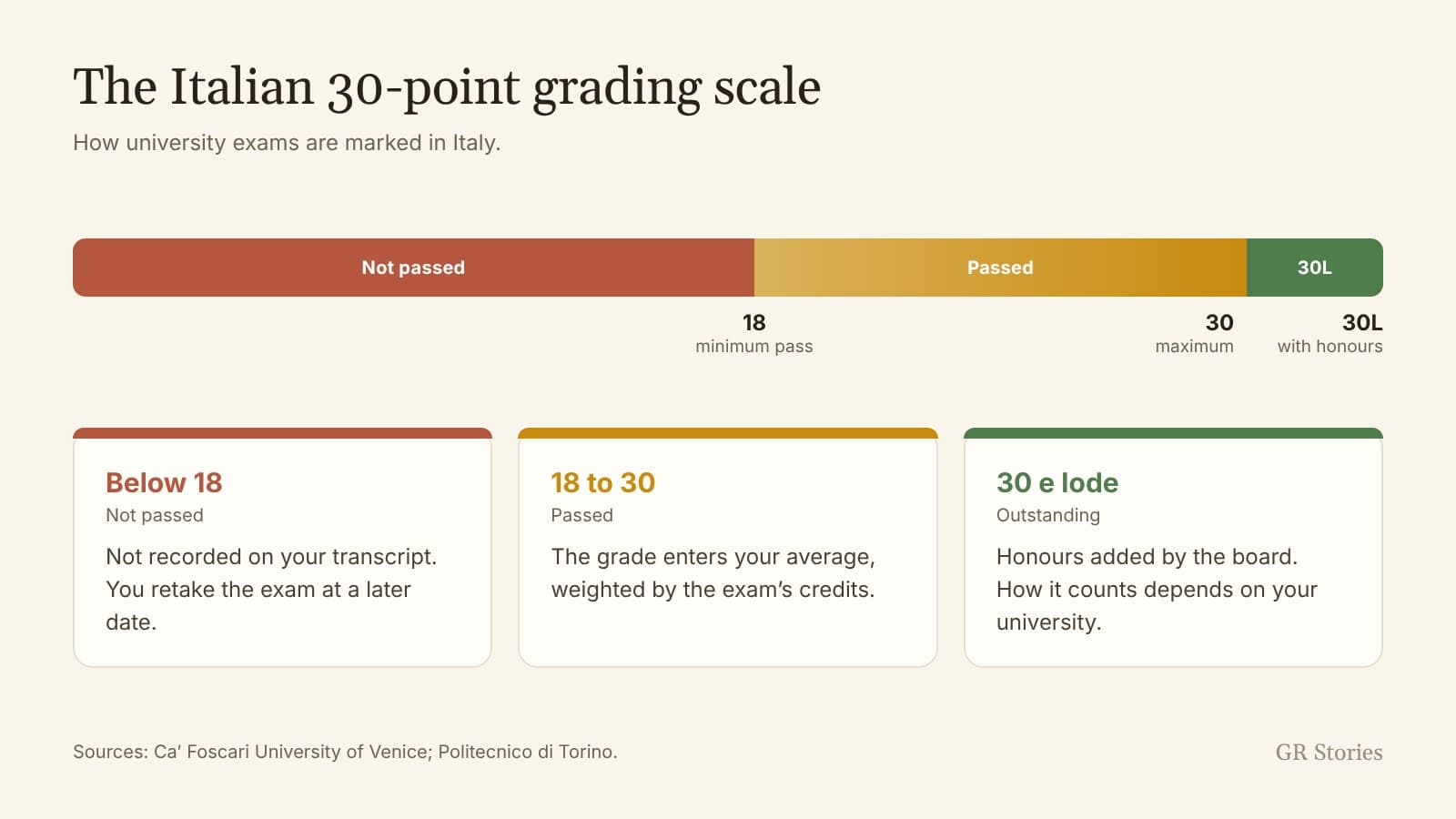
There is no official table of what each number "means", and the distribution of grades varies a lot between subjects: a 26 in a demanding engineering course can be an excellent result. As a rough guide, though, many students see the low twenties as a pass, the mid-to-high twenties as a good to very good result, and 30 or 30 e lode as excellent.
Some activities are not graded at all. Language tests, internships and some workshops are often marked simply as passed, an idoneità, and give you credits without affecting your average.
You Can Often Say No to a Grade
Here is something many international students do not expect: at most Italian universities, a passing grade is an offer, not a verdict. If you are not happy with it, you can refuse it, and take the exam again at a later date.
How it works depends on the university and the exam. At Ca' Foscari, for example, students accept or refuse an oral exam grade at the end of the exam itself, while written exam results arrive by email and can be refused through the student portal. If you do nothing, the grade is recorded on your transcript.
Refusing makes sense when a grade would pull your average down and you are confident you can do better. It does not make sense if it means repeating the whole preparation for one or two extra points while the rest of your exams pile up. And if your exam is oral, as so many are in Italy, our guide on how to prepare for an oral exam will help you get the grade you want the first time.

CFU: How Italy Counts Your Work
Every exam is worth a number of credits, called CFU (crediti formativi universitari). One CFU corresponds to 25 hours of student work, including lectures, lab sessions and the hours you spend studying on your own. A full-time year is worth 60 CFU.
Italian CFU are the same as the European ECTS credits: 1 CFU = 1 ECTS. A bachelor's degree (laurea triennale) requires 180 CFU, and a master's degree (laurea magistrale) another 120 CFU. At Ca' Foscari, for example, most courses are worth 6 to 9 CFU, or 12 to 18 if they are split into two modules.
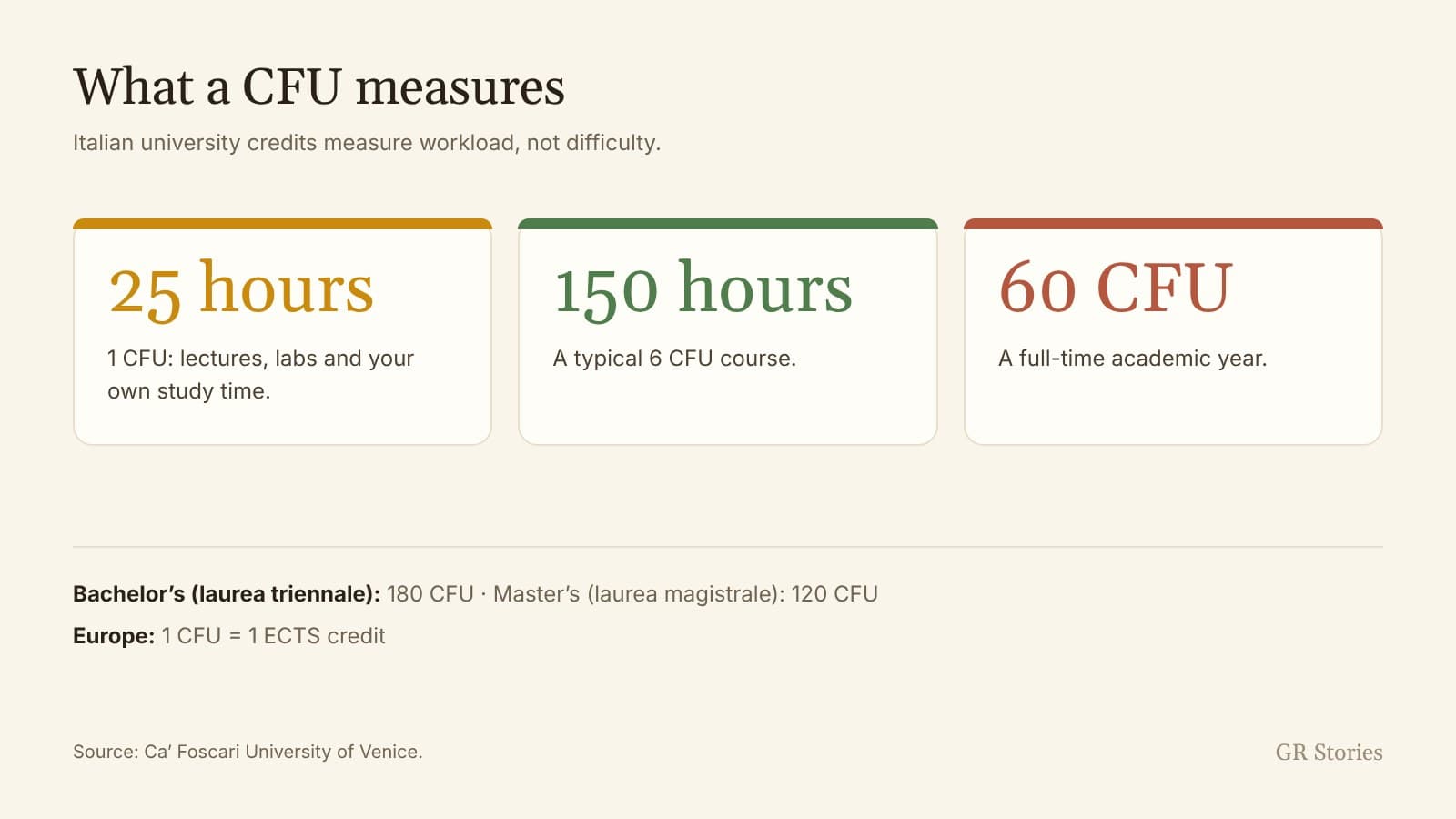
Credits matter twice. They tell you how much work a course should take, which is useful when you plan your semester, and they decide how much each exam weighs in your average.
Your Average Is Weighted by Credits
The average that counts at Italian universities is a weighted average (media ponderata): each grade is multiplied by the credits of its exam, and the total is divided by the sum of the credits. A 12-CFU exam counts twice as much as a 6-CFU one.
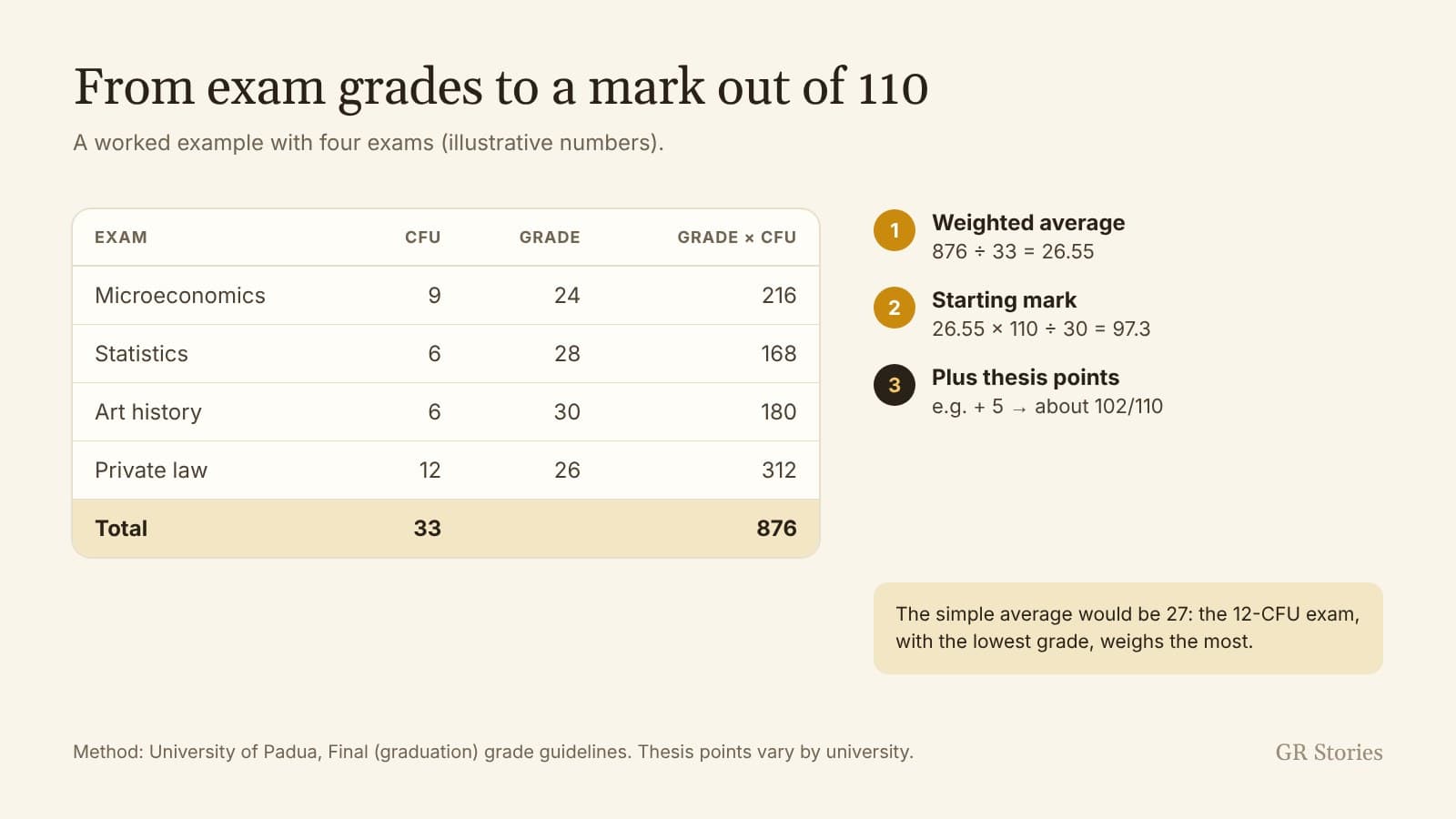
In the example above, the simple average of the four grades would be 27. The weighted average is 26.55, because the biggest exam, worth 12 credits, has the lowest grade. This is why it is worth putting your best effort into the courses with the most credits: they move your average far more than the small ones.
How a 30 e lode counts in the average also depends on the university. Some count it as a plain 30, some as 31, and others give extra points at graduation for the credits you passed with lode.
The Final Degree Mark Out of 110
Your degree has its own scale: the final mark is expressed out of 110. The minimum is 66/110, the maximum is 110/110, and the graduation committee can award 110 e lode, the highest honour.
The calculation starts from your weighted average, converted from thirtieths into hundred-and-tenths. As the University of Padua puts it:
weighted average × 110 ÷ 30 = starting mark
In the example above, 26.55 × 110 ÷ 30 gives a starting mark of about 97.3. To this, the committee adds points for your thesis and its defence and, depending on the rules of your degree, for things such as exams passed with lode or graduating on time. How many points can be added varies a great deal: at Padua, in the programme whose rules we quoted, the increase cannot exceed 8% of the weighted average, while other universities set a fixed maximum. So with a starting mark of 97.3 and five extra points, you would graduate with 102/110, depending on how your university rounds.
To graduate with 110 e lode, you usually need a high starting mark, an excellent thesis and the agreement of the whole committee. Your university's graduation guidelines will tell you exactly how the points are assigned.
Exam Sessions and Appelli
Italian exams take place in sessions (sessioni), and each session offers one or more exam dates, called appelli. You usually register online for the date you want: at Ca' Foscari, registration opens 15 days before the exam and closes 4 days before. Miss the deadline and you cannot sit that date.
If you fail, miss or refuse an exam, you can take it again at a later appello. That flexibility is useful, but it is also a trap: postponing exams is easy, and they pile up quickly. Plan your sessions the way you would plan your study, starting from the dates and working backwards. Our guide on how to study smarter at university shows how.

If You Are on Erasmus
If you are in Italy on an exchange, your Italian grades will be converted into your home university's system when you return. Italian universities publish statistics on how their grades are distributed for each degree course, and the Politecnico di Torino, for example, updates its tables every year. Your home university uses tables like these to convert your results fairly.
A few practical tips: agree your learning agreement before you take any exams, keep a copy of your transcript of records, and ask the international office how lode and refused grades are handled before your first session. If you are studying in Italian, our article on what AI can't do when you study in another language is worth a read.
Common Misunderstandings
- "18 is a fail." It is not: 18 is the minimum pass.
- "30 is 100%." Not quite. The scale is not a percentage, and 30 is not the ceiling: 30 e lode sits above it.
- "A failed exam ruins my transcript." Failing grades are not recorded. You only see the exams you have passed.
- "I have to accept whatever grade I get." At most universities you can refuse a passing grade and try again.
- "All exams count the same." Your average is weighted by credits, so a 12-CFU exam counts twice as much as a 6-CFU one.
- "My degree mark is just my average." It starts from your average, converted to 110, but the thesis and other points are added on top.
The Bottom Line
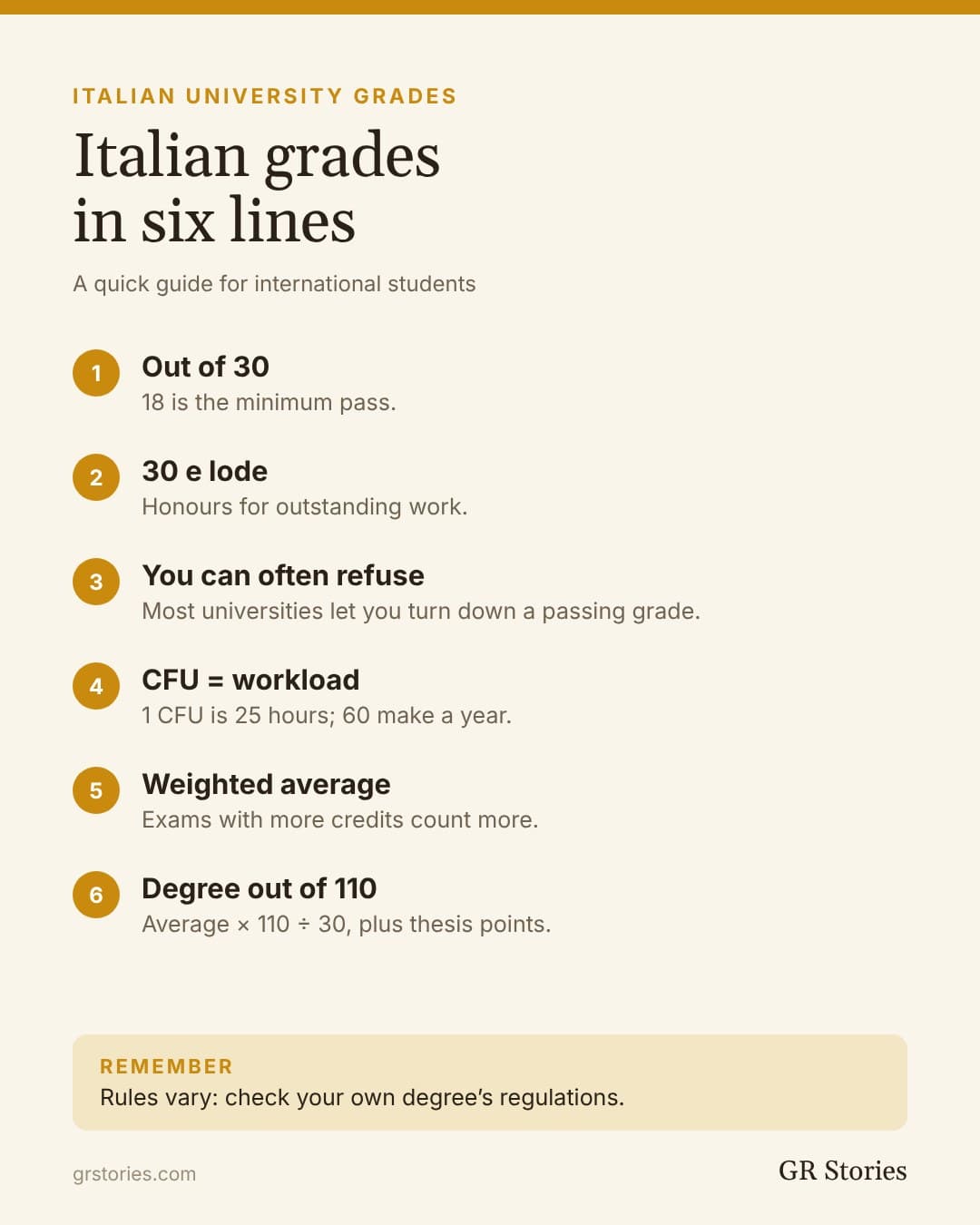
Once you know the rules, the Italian system is easier to read than it first looks: exams out of 30, with 18 to pass and 30 e lode at the top; credits that measure your workload and weigh your average; and a final mark out of 110 that starts from that average and adds points for your thesis.
The details change from one university to the next, so read your course regulations and graduation guidelines early, not in your final semester. And if you are still settling into Italian student life, our guide to renting in Turin and three things that surprise students at European universities are good places to start.
Sources and Photo Credits
- Ca' Foscari University of Venice, Exams: instructions (grading scale, CFU, accepting and refusing grades, exam registration).
- Politecnico di Torino, ECTS grading system.
- University of Padua, Final (graduation) grade – Master's Degree Programmes.
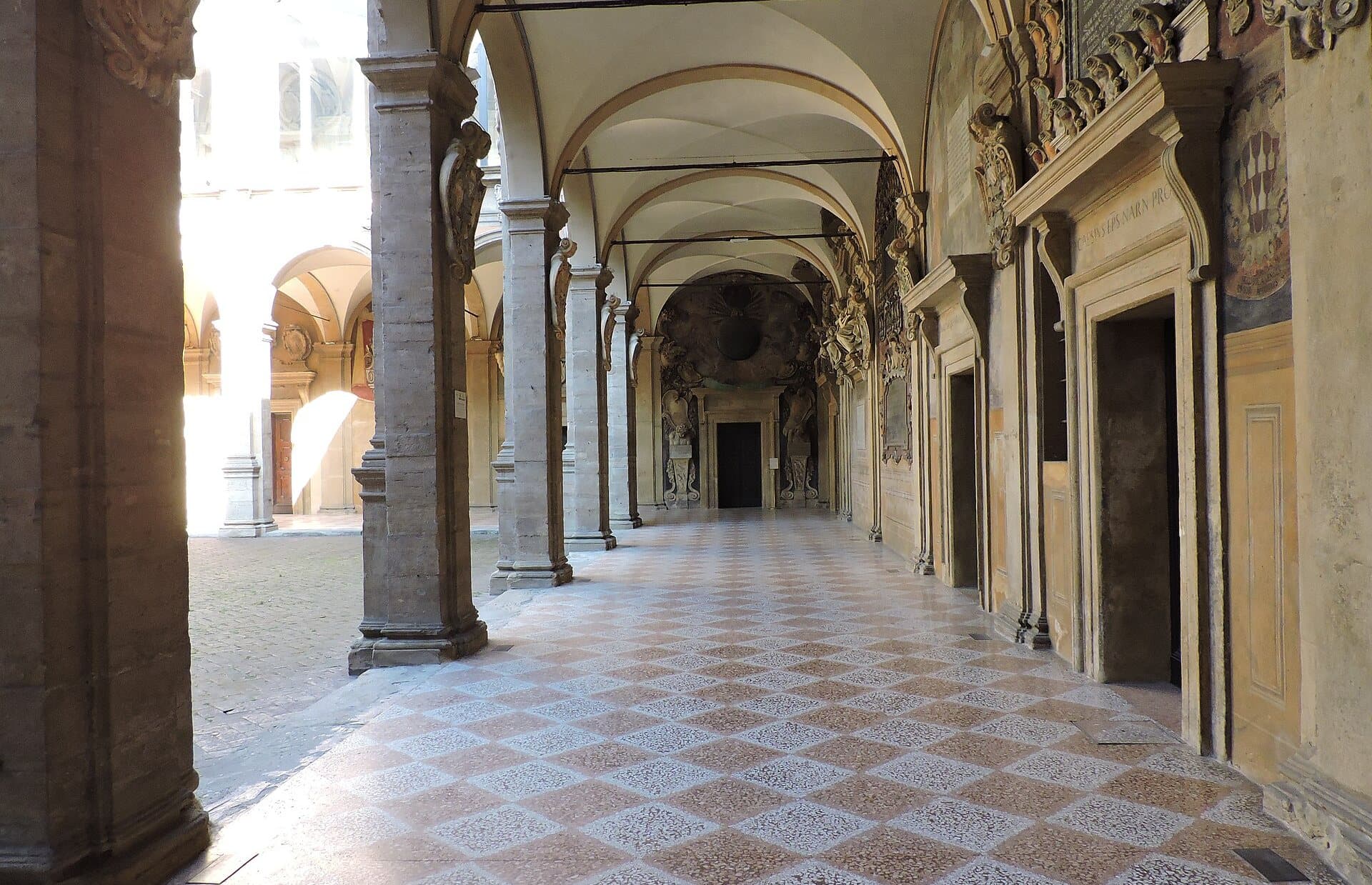
- Cover: the courtyard of the Archiginnasio, Bologna, the historic seat of the University of Bologna, photo by Dimitris Kamaras, CC BY 2.0, via Wikimedia Commons.
- Lecture in Bologna: Laurentius de Voltolina, 14th century, public domain, via Wikimedia Commons.
- Aula magna, Naples: photo by Alberto Mura, public domain, via Wikimedia Commons.
- Student record book: Czech Technical University in Prague, public domain, via Wikimedia Commons.
- Grading scale, CFU chart, worked example and summary card: original graphics by GR Stories.