If you are applying to university in the United Kingdom, there is one part of your application that only you can write: the personal statement. Your grades, predicted grades and reference come from your school; the personal statement is your chance to explain, in your own words, why you want to study your subject and why you would be good at it.
It recently changed shape. For courses starting from 2026, UCAS replaced the old single essay with three questions, each with its own box. The total length is the same, 4,000 characters including spaces, but the structure is now built in. That makes it easier to know what to write, and easier to see when something is missing.
This guide explains the new format and how to tackle each question, using UCAS's own guidance, with the key dates for students applying for 2027 entry.

The Three Questions
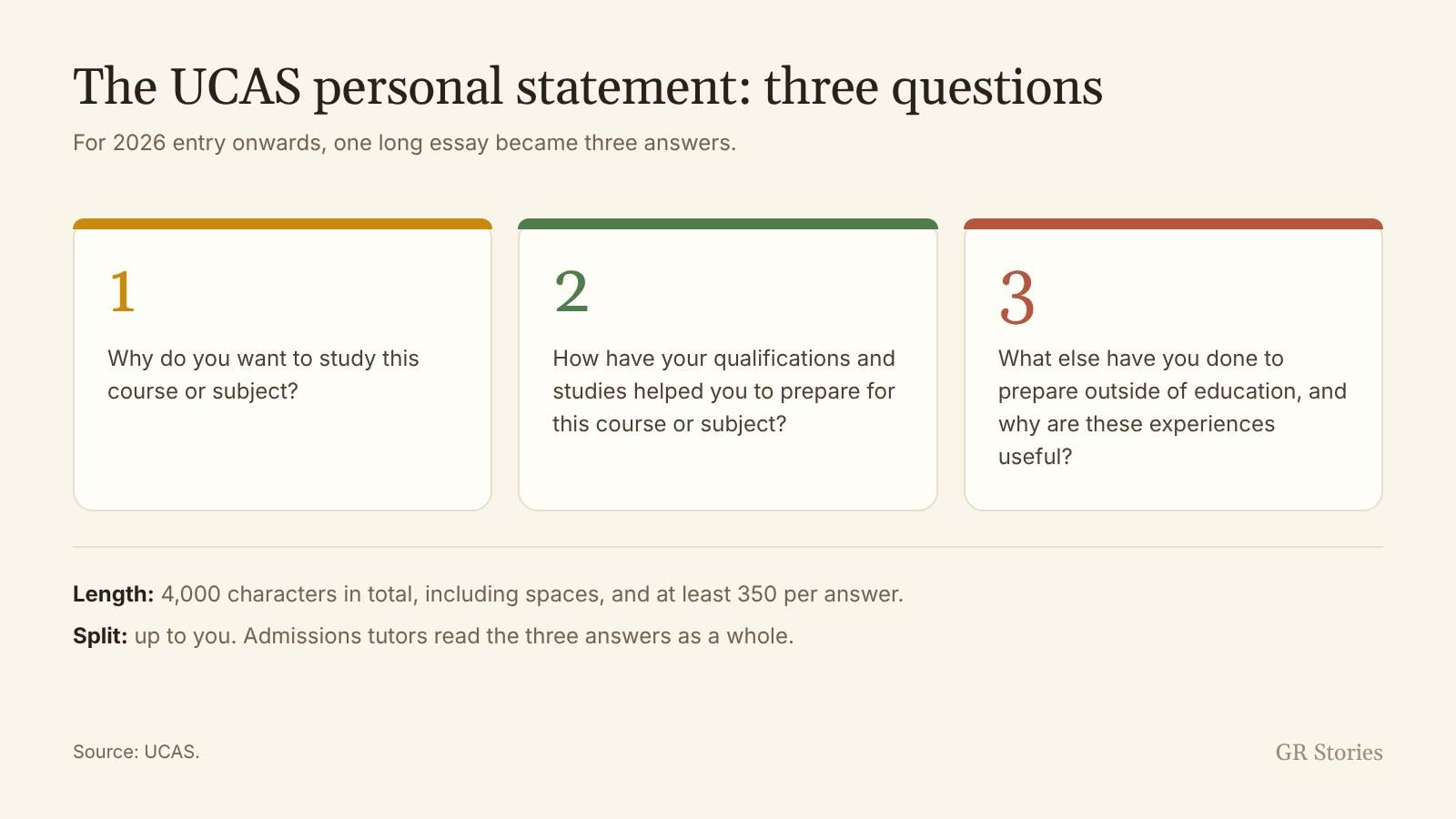
The personal statement now asks:
- Why do you want to study this course or subject?
- How have your qualifications and studies helped you to prepare for this course or subject?
- What else have you done to prepare outside of education, and why are these experiences useful?
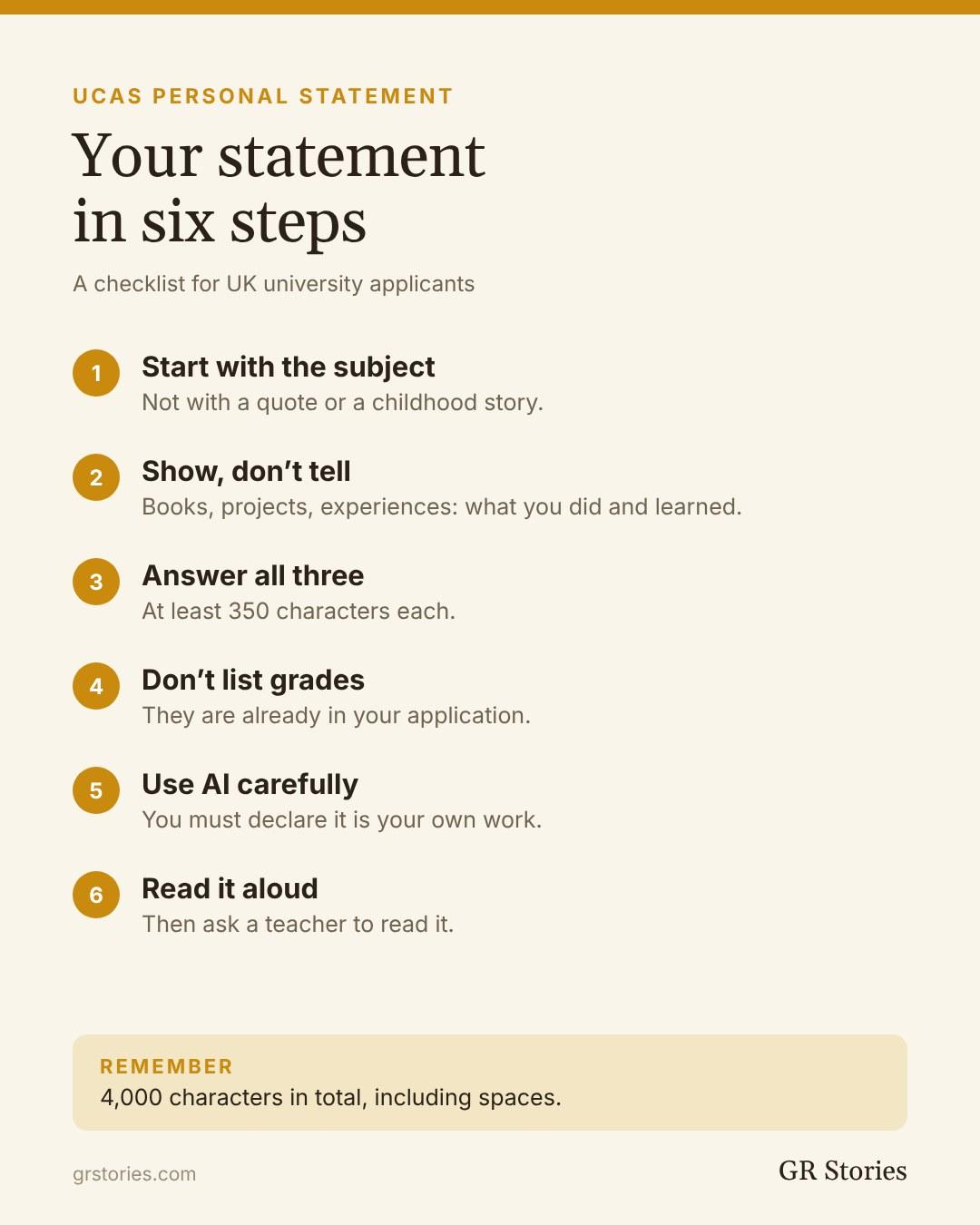
Each answer must be at least 350 characters, and the three together can use up to 4,000 characters, including spaces. There is no fixed split: you decide how much to write for each, depending on your course and your experience. UCAS also stresses that admissions staff read the statement as a whole, so there is no "wrong" place for a piece of evidence, as long as you don't repeat yourself.
Question 1: Why This Subject?
This is where you show your motivation and your knowledge of the subject. UCAS suggests thinking about what has driven you towards it: a role model, a moment, a book, a subject expert, a podcast, a news story.
The key is to go beyond enthusiasm. Saying that you are "passionate about economics" proves nothing; explaining what you read about inflation, what puzzled you and what you did to find out more proves a great deal. UCAS calls this super-curricular activity: exploring your subject beyond the classroom. If you have a career in mind, you can mention it, but the focus should be on the subject itself.
Question 2: Your Studies
Here you explain how your formal education has prepared you: your current qualifications, a particular module, an essay or project, an online university course. Focus on what is most recent and most relevant, and on the skills you have built: analysis, problem-solving, writing, lab work.
One thing UCAS is clear about: don't list your grades. Universities already see them elsewhere in your application. Use the space instead for achievements, such as a competition, a role as student ambassador or a project that shaped your interests. If you are taking the IB, your Extended Essay can be excellent material here.
Question 3: Beyond the Classroom
The third question is about everything else: work experience, volunteering, part-time jobs, sport, music, responsibilities at home, a challenge you have overcome. The rule is always the same: reflect. Don't just say what you did; say what you learned and why it matters for your course.
For international students, UCAS adds a useful tip: this is a good place to explain why you want to study in the UK.
Using AI: Be Careful
When you submit your application, you now have to declare that your personal statement has not been copied or provided from another source, including artificial intelligence software. UCAS's verification team checks statements for similarity, and universities can be told if parts of yours look like other people's.
That doesn't mean you can't use AI at all. UCAS's advice is about balance: using a chatbot to brainstorm, check your structure or spot weaknesses is very different from pasting in a generated text. Our guide on how to write a good AI prompt can help you get useful feedback, and our article on what AI can't do when you study in another language explains why your own voice matters.
Key Dates for 2027 Entry
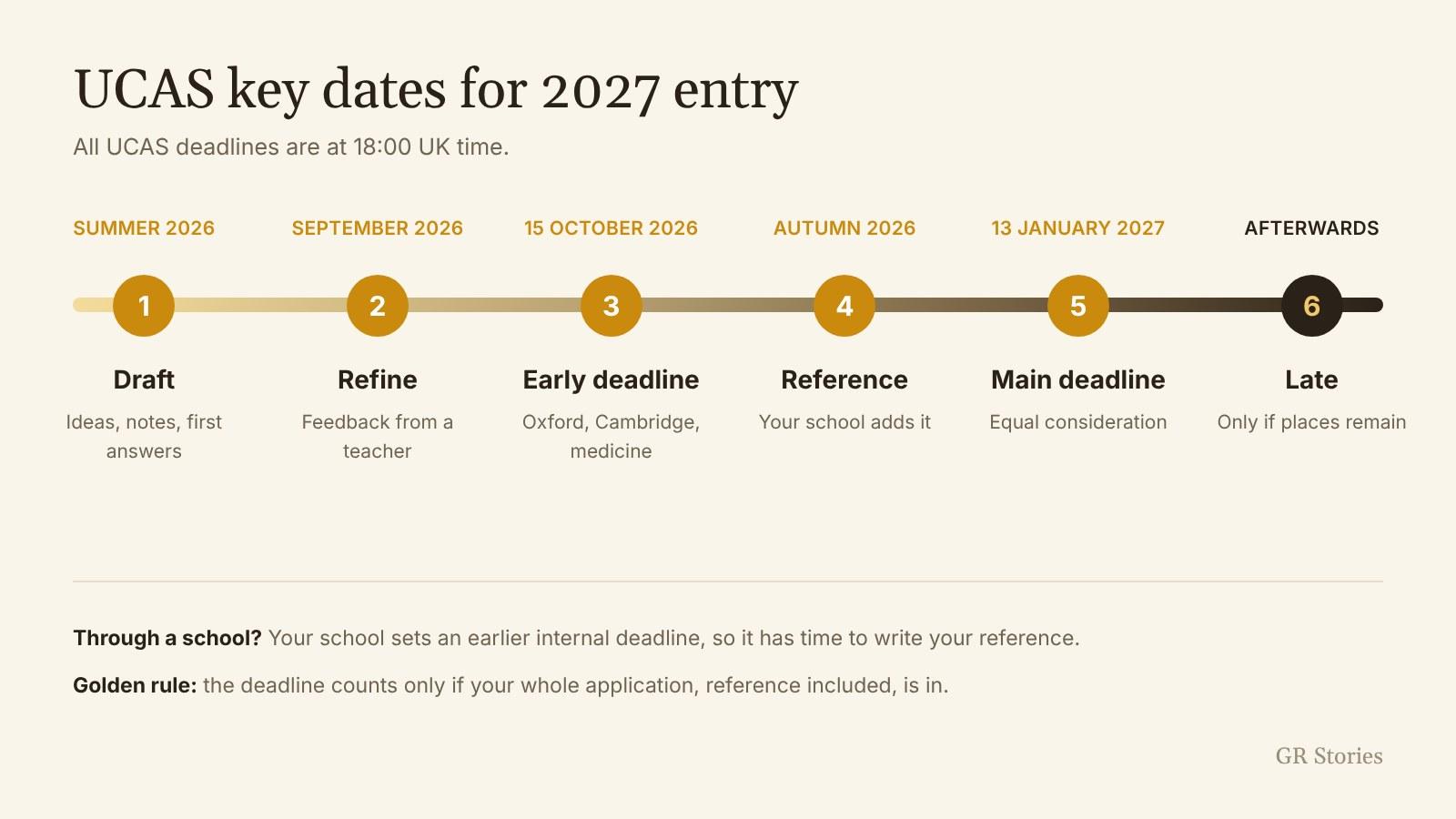
All UCAS deadlines are at 18:00 UK time:
- 15 October 2026: for any course at Oxford or Cambridge, and for most courses in medicine, dentistry and veterinary medicine or science.
- 13 January 2027: the equal consideration deadline for most other courses.
Applications that arrive by the deadline, complete with your reference, are guaranteed to be considered. After the deadline, you can still apply to many courses, but only if they have places left. You can choose up to five courses, and you write one personal statement for all of them, so if your choices are very different, focus on what they have in common.
If you apply through your school, it will set an earlier internal deadline, to leave time to write and attach your reference.
Common Mistakes
- Starting with a famous quote. Admissions tutors have read them all. Start with your own idea or experience.
- Listing without reflecting. Ten activities with no explanation say less than two that you reflect on properly.
- Repeating your grades. They are already in your application.
- Writing for every course at once. Your five choices share one statement, so choose courses that are related.
- Leaving it to the last week. Good statements go through several drafts. Start in the summer.
- Letting someone else write it. Teachers can give feedback; the words must be yours.
The Bottom Line
The new three-question format makes the personal statement more structured, but the goal has not changed: show that you understand your subject, that you have prepared for it and that you will thrive on the course. Write about what you have actually done, reflect on it honestly and start early. And if your application leads to an interview, our guide on how to prepare for an oral exam will help you prepare for that too.
Sources and Photo Credits
- UCAS, How to write your personal statement (the three questions, character limits, what to include).
- UCAS, Personal statement tips for international students.
- UCAS, A guide to using AI and ChatGPT with your personal statement.
- UCAS, When to apply and 2027 entry deadline for Oxford, Cambridge and medicine.
- Cover: Person using MacBook Pro on a wooden table by Justin Morgan, Unsplash.
- Library: A woman looking at a book on a shelf in a library by Declan Sun, Unsplash.
- Three-question cards, key dates and summary card: original graphics by GR Stories.