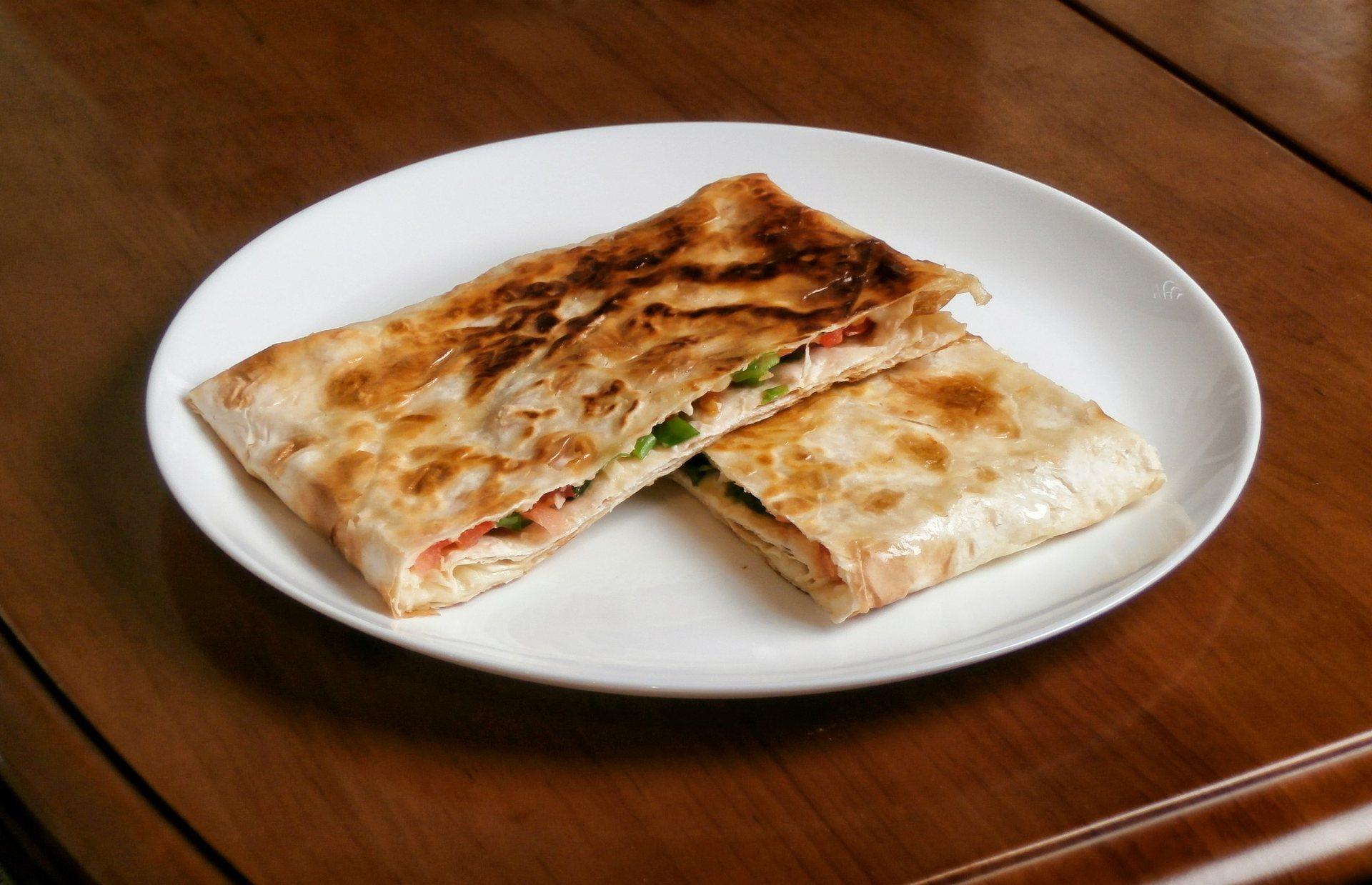
Along the Adriatic coast of Romagna, and in every town inland, you will find small kiosks selling piadina: a thin, soft flatbread made with flour, water, salt and lard, cooked in a few minutes on a very hot griddle, then folded around a filling and eaten warm, often standing up. It is the region's bread, its sandwich and its street food all at once.
The classic fillings are simple: prosciutto crudo, or squacquerone, Romagna's soft, tangy fresh cheese, with a handful of rocket. But a good piadina is a pleasure even on its own, still warm from the pan.
This version follows the piadina romagnola published by Il Cucchiaio d'Argento, the classic Italian cookbook first published in 1950. It uses five store-cupboard ingredients, takes fifteen minutes of work and an hour's rest, and makes 8 or 9 piadine. Judging by the amount of fat, Il Cucchiaio d'Argento says, its version is closest to the piadina of Cesena, which is more sparing with lard or oil.
The Bread of Romagna
For centuries, as the consortium that protects it explains, piadina was a stand-in for bread. Bread was baked once a week; in between, families made piadina, which needed no oven and no rising, only a hot griddle. According to the Emilia-Romagna regional government, it was the poet Giovanni Pascoli who made the word piada official, turning the dialect word piè into Italian, and who described it as the "national bread" of the people of Romagna, almost as old as mankind itself.
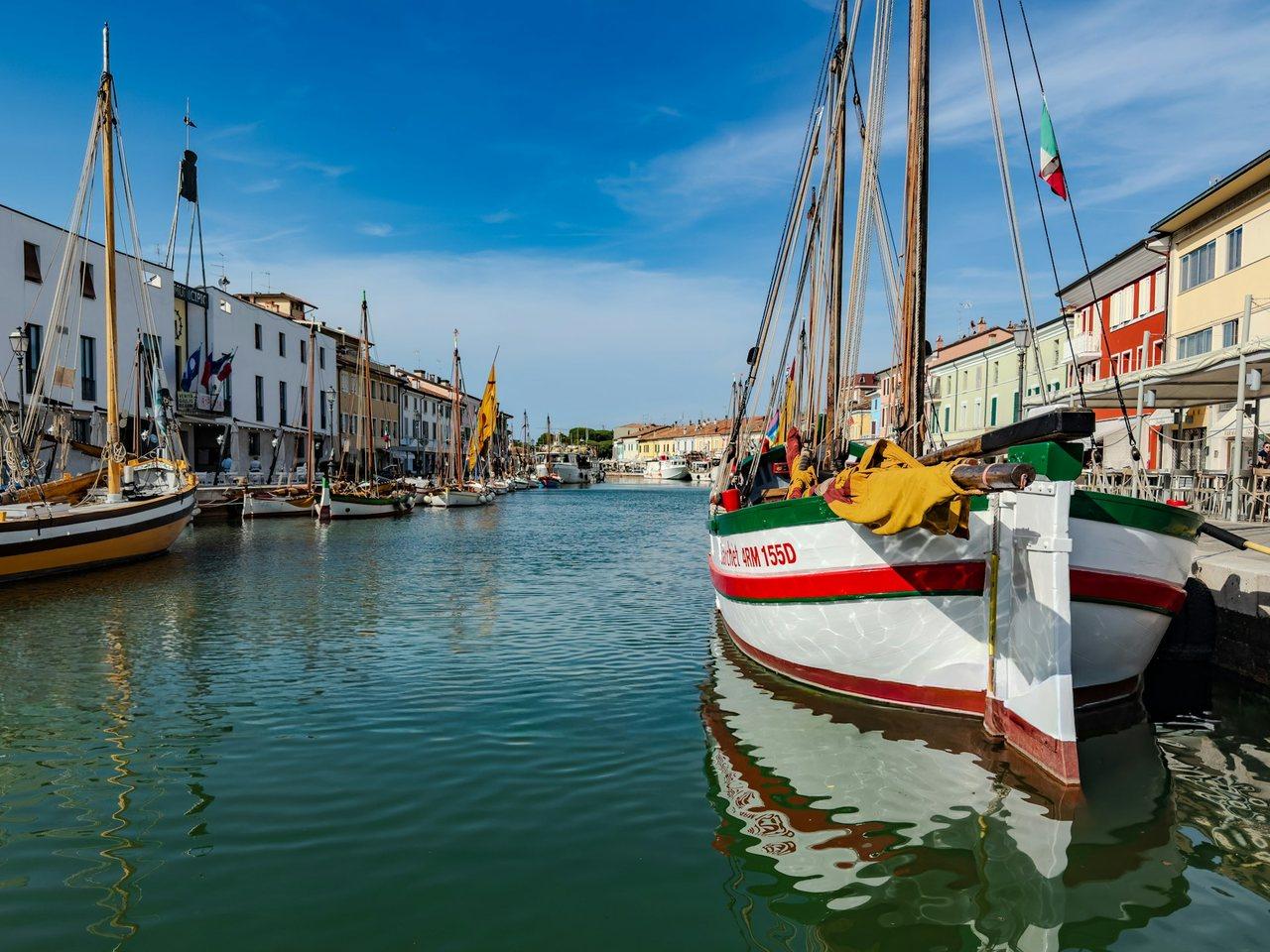
After the Second World War, the consortium writes, piadina stopped being a substitute for bread and became a dish in its own right. From the 1970s, artisan makers and the kiosks along the riviera joined the home cooks, and piadina became the taste of summer by the sea.
In 2014 the European Union recognised Piadina Romagnola, or Piada Romagnola, as a Protected Geographical Indication (IGP in Italian). The protected area covers the provinces of Rimini, Forlì-Cesena and Ravenna, plus part of the province of Bologna, up to the historic course of the Sillaro river, around Imola. The rules recognise two types: the classic piadina, 15 to 25 cm across and 4 to 8 mm thick, and the piadina alla Riminese, wider (23 to 30 cm) and no more than 3 mm thick, softer and more flexible. Everyone in Romagna has an opinion about which is better. Rolled to 2–3 mm, the piadine in this recipe are thinner than the classic type. The rules also say what may go into the dough: more on that below.
Ingredients
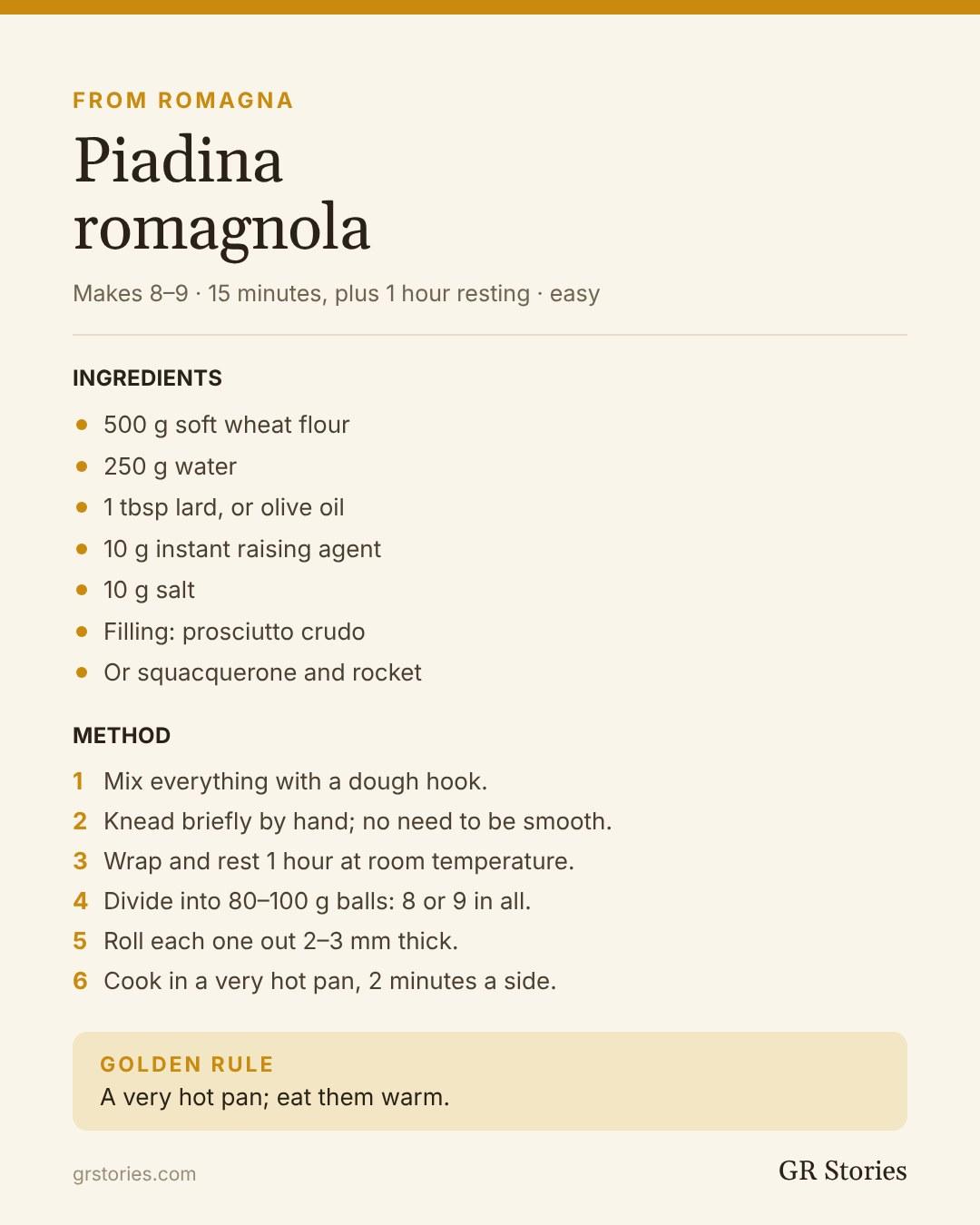
Serves 8 to 9 (makes 8 or 9 piadine). Preparation: 15 minutes. Resting: 1 hour. Cooking: 3–4 minutes each. Difficulty: easy.
- 500 g soft wheat flour
- 250 g water
- 1 tablespoon lard, at room temperature
- 10 g lievito istantaneo, an instant raising agent (see the note below)
- 10 g salt
To fill, as Il Cucchiaio d'Argento does: prosciutto crudo, or squacquerone and rocket, as much as you like.
You will also need a stand mixer with a dough hook (or a large bowl and your hands), cling film, a rolling pin and a large non-stick frying pan. In Romagna, piadina is traditionally cooked on a testo, a terracotta griddle; today, as Il Cucchiaio d'Argento explains, cast-iron or steel ones are more common. A heavy frying pan does the job perfectly at home.
A Note on Ingredients
Flour. The recipe uses farina di grano tenero, soft wheat flour: in Italy, a 00 or 0 flour; abroad, plain or all-purpose flour. Avoid strong bread flour, which makes the dough springy and hard to roll thin.
Lard or olive oil. Lard, strutto, is the traditional fat and gives piadina its soft, slightly flaky bite. The IGP rules allow lard or olive oil, including extra virgin, and Il Cucchiaio d'Argento notes in another of its piadina recipes that olive oil makes the dough a little lighter and suitable for vegetarians and vegans (depending, of course, on the filling). To swap, use a tablespoon of olive oil in place of the lard.
Lievito istantaneo, and what the IGP rules say. Here the home recipe and the protected one part ways. The IGP specification lists just four basic ingredients: soft wheat flour, water, salt and fat (lard and/or olive oil). As Il Cucchiaio d'Argento explains in its guide to cooking piadina, raising agents are allowed only as an optional extra, and the ones listed are sodium bicarbonate, disodium diphosphate and corn or wheat starch. There is no yeast in the protected base dough, and the consortium's own home recipe uses none. Il Cucchiaio d'Argento's recipe adds 10 g of lievito istantaneo without saying exactly which product it means. In Italian kitchens the term usually refers to a powdered raising agent sold in sachets for savoury bakes, not brewer's yeast; elsewhere on Il Cucchiaio d'Argento it is described as giving a batter that is ready to use with no rising time. Check the label: if it lists sodium bicarbonate and diphosphates, it belongs to the same family of raising agents that the rules allow. Abroad, do not confuse it with "instant yeast", which is dried brewer's yeast: if you cannot find an Italian savoury raising agent, baking powder is the closest match. Or leave it out, as the IGP base dough does: your piadina will simply be a little flatter and more compact.
Fillings. Squacquerone di Romagna is a DOP cheese and can be hard to find outside Italy. Abroad, look for stracchino or crescenza, or use any soft, spreadable fresh cheese. Any good prosciutto crudo works, from Parma or San Daniele.
Method
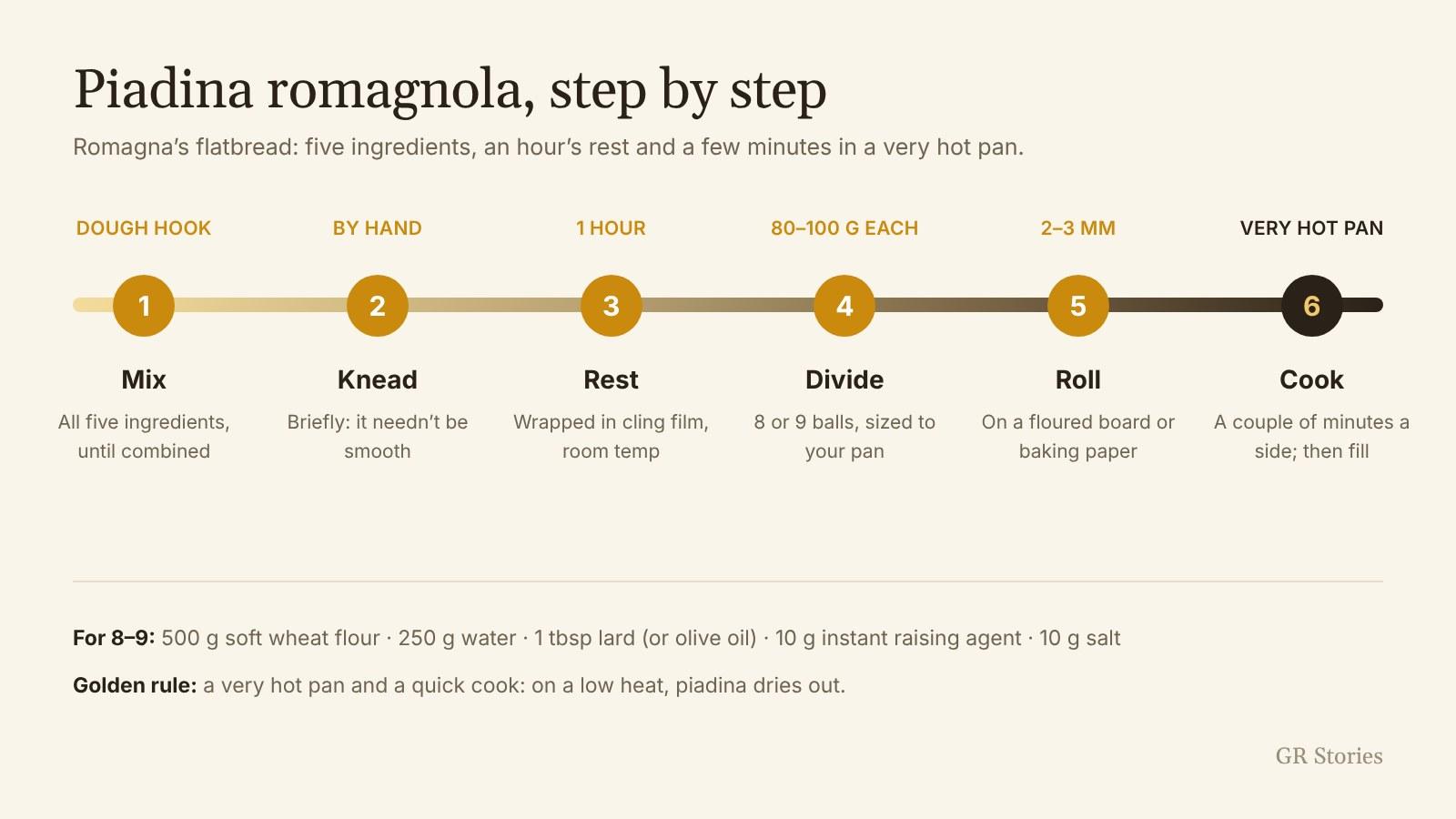
Step 1 — Mix
Put the flour, water, lievito istantaneo, salt and lard in the bowl of a stand mixer and work them with the dough hook until they come together. No mixer? Mix everything in a large bowl with a fork, then with your hands.
Step 2 — Knead briefly
Turn the dough out onto the worktop and knead it briefly with your hands, just until it is even. It does not need to be particularly smooth.
Step 3 — Rest
Shape the dough into a ball, wrap it in cling film and leave it to rest for 1 hour at room temperature.
Step 4 — Divide
Cut the dough into pieces of 80 to 100 g each, depending on the size of your pan: you should get 8 or 9. Roll each piece into a ball.
Step 5 — Roll out
On a lightly floured worktop, or on a sheet of baking paper, roll each ball out with a rolling pin into a round 2 to 3 mm thick.
Step 6 — Cook
Heat the frying pan until it is very hot. Cook the piadine one at a time, giving each one a turn now and then so that it cooks evenly, for a couple of minutes per side, until it is lightly golden and dotted with small dark spots. If big bubbles puff up, Il Cucchiaio d'Argento's guide suggests pricking them with a fork.
Step 7 — Fill and serve
Put the piadine on a chopping board while they are still hot and cut them in half with a knife. Fill some with prosciutto crudo and some with squacquerone and rocket, and eat them warm.
Is it ready? A piadina is done when it is lightly golden, covered in the little dark spots that Romagna calls macò, and still soft and pliable. Il Cucchiaio d'Argento's guide recommends a cooking surface of 200 to 250°C and no more than about 4 minutes in total: on a low heat, it takes longer and dries out.
Making them ahead. Piadine are best warm, but you can make them in advance. Rather than putting them in the fridge, Il Cucchiaio d'Argento suggests covering them with a cotton cloth so that they stay soft. Warm them for a few seconds on each side in a hot pan before filling.
Common Mistakes (and How to Avoid Them)
- A pan that is not hot enough. On a low heat, piadina dries out before it colours and turns into a cracker. Heat the pan well first.
- Skipping the rest. Unrested dough keeps springing back under the rolling pin. Give it the full hour.
- Overworking the dough. A brief knead is enough. It does not need to be smooth and silky like bread dough.
- Uneven rolling. Thin edges burn while a thick centre stays raw. Aim for an even 2–3 mm all over.
- Too much flour on the board. Excess flour burns in the hot pan. Dust lightly and brush off any extra before cooking.
- Piling them up uncovered. Stacked in the open air, they go hard. Keep them under a cotton cloth.
What to Serve with It
Start with the two classics Il Cucchiaio d'Argento suggests: prosciutto crudo, or squacquerone and rocket. After that, anything goes: grilled vegetables, mozzarella and tomato, leftover roast meat. And remember that piadina began life as bread: it is just as good alongside a plate of grilled meat or vegetables, or a bowl of soup.
Why This Recipe Belongs in a Student Kitchen
Flour, water, salt and a spoonful of fat: piadina costs almost nothing, needs no oven and is ready in a little over an hour, most of which is the dough resting while you do something else. Keep a few under a tea towel and lunch is always a couple of minutes away: a warm piadina with whatever is in the fridge is the ideal study-break meal. For the rest of the break, see our tips on how to study smarter at university.
It is also the perfect dish to make with flatmates: one rolls, one cooks, everyone chooses their own filling. There are few better ways to break the ice in a shared student kitchen. And if you love the combination of fresh cheese and greens, try our caprese next.
Sources and Photo Credits
- Recipe: adapted from Il Cucchiaio d'Argento's Piadina romagnola; olive oil note from its Piadina con il Bimby.
- The IGP rules, raising agents, the testo, cooking and keeping: Il Cucchiaio d'Argento, Come cucinare la piadina.
- Lievito istantaneo: Il Cucchiaio d'Argento, Frittelle di fiori di zucca.
- History, the IGP and the two types of piadina: Consorzio di Promozione e Tutela della Piadina Romagnola, History, Regulation and Piadina Romagnola IGP.
- Pascoli, the word piada and the production area: Regione Emilia-Romagna, Piadina o Piada romagnola Igp.
- Cover: A filled flatbread cut in half by Igor Bakbardin, Unsplash.
- Cesenatico: Fishing boats on the canal of Cesenatico by Sue Winston, Unsplash.
- Illustrations: © GR Stories.