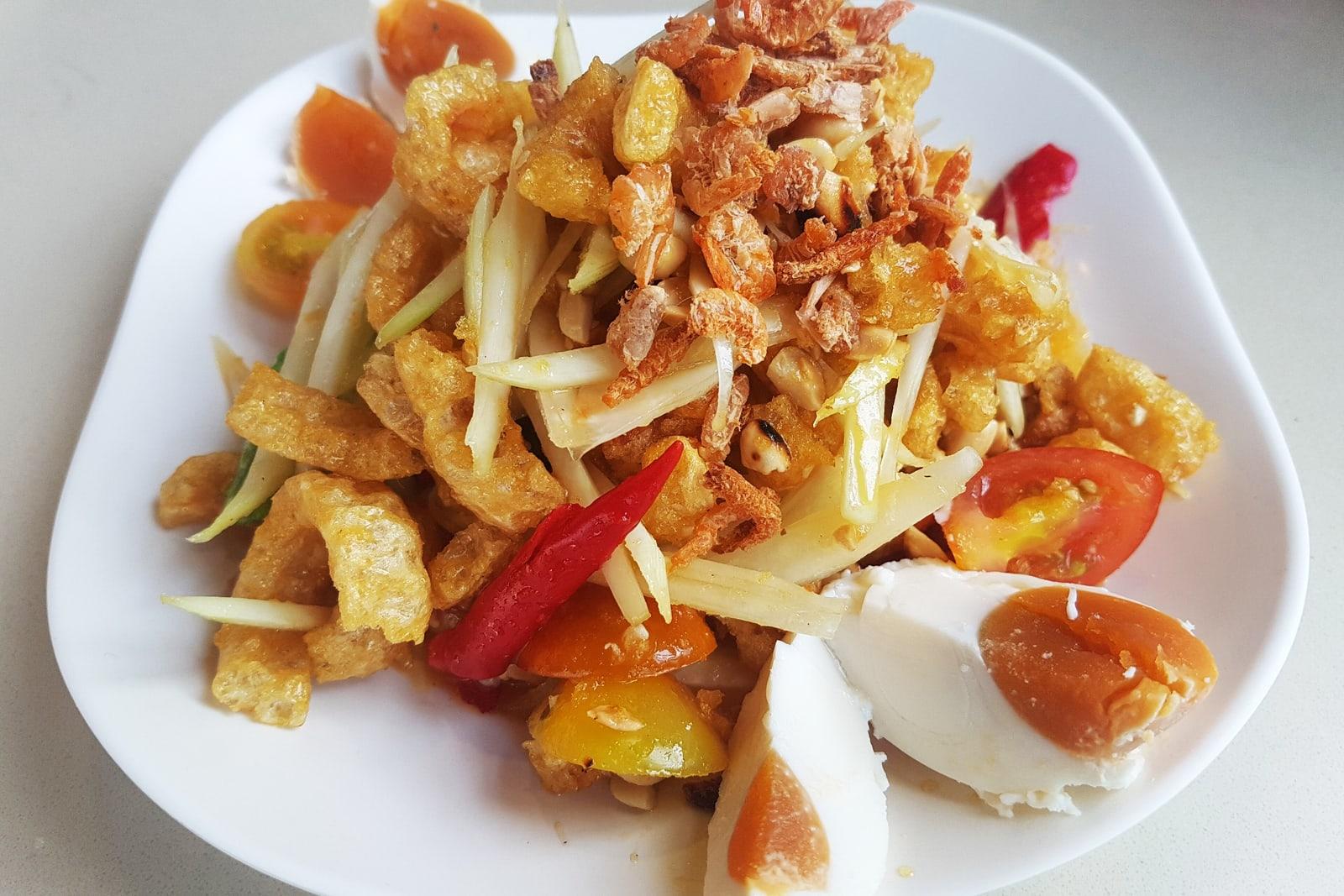
If you have ever walked through a Thai market, you have probably heard som tam before you saw it: the steady tok, tok, tok of a wooden pestle in a deep mortar, as a vendor pounds garlic and chillies, throws in strips of green papaya, squeezes a lime and tastes the dressing straight from the spoon. A few minutes later you are handed a salad that is crunchy, sour, salty, a little sweet and, depending on how brave you were when you ordered, anywhere from pleasantly warm to properly fiery.
Som tam is not your average salad. There are no leaves, no oil and no vinaigrette. It is built on unripe papaya, which is crisp and almost neutral in flavour, and on a dressing that hits four tastes at once. It is one of the most loved dishes in Thailand and Laos, it costs very little to make, it needs no cooking at all, and once you have the basic ingredients in your cupboard you can make it in about twenty minutes.
Where Som Tam Comes From
The name already tells you how it is made. In Lao and Thai, tam means to pound in a mortar, and som means sour: som tam is, quite literally, a "sour pounded" salad. In Laos it is called tam mak hoong, "pounded papaya", or tam som, and the Thai name simply turns those two words around.
The dish is generally believed to have been created by the Lao people, and it is still considered one of the national dishes of Laos. In Thailand it is most closely associated with Isan, the north-eastern region, where most people are ethnically Lao. From there it travelled south: in the mid-20th century, workers moving from the north-east to Bangkok brought their recipes with them, and som tam slowly went from street carts near construction sites and boxing stadiums to one of the most popular dishes in the country.
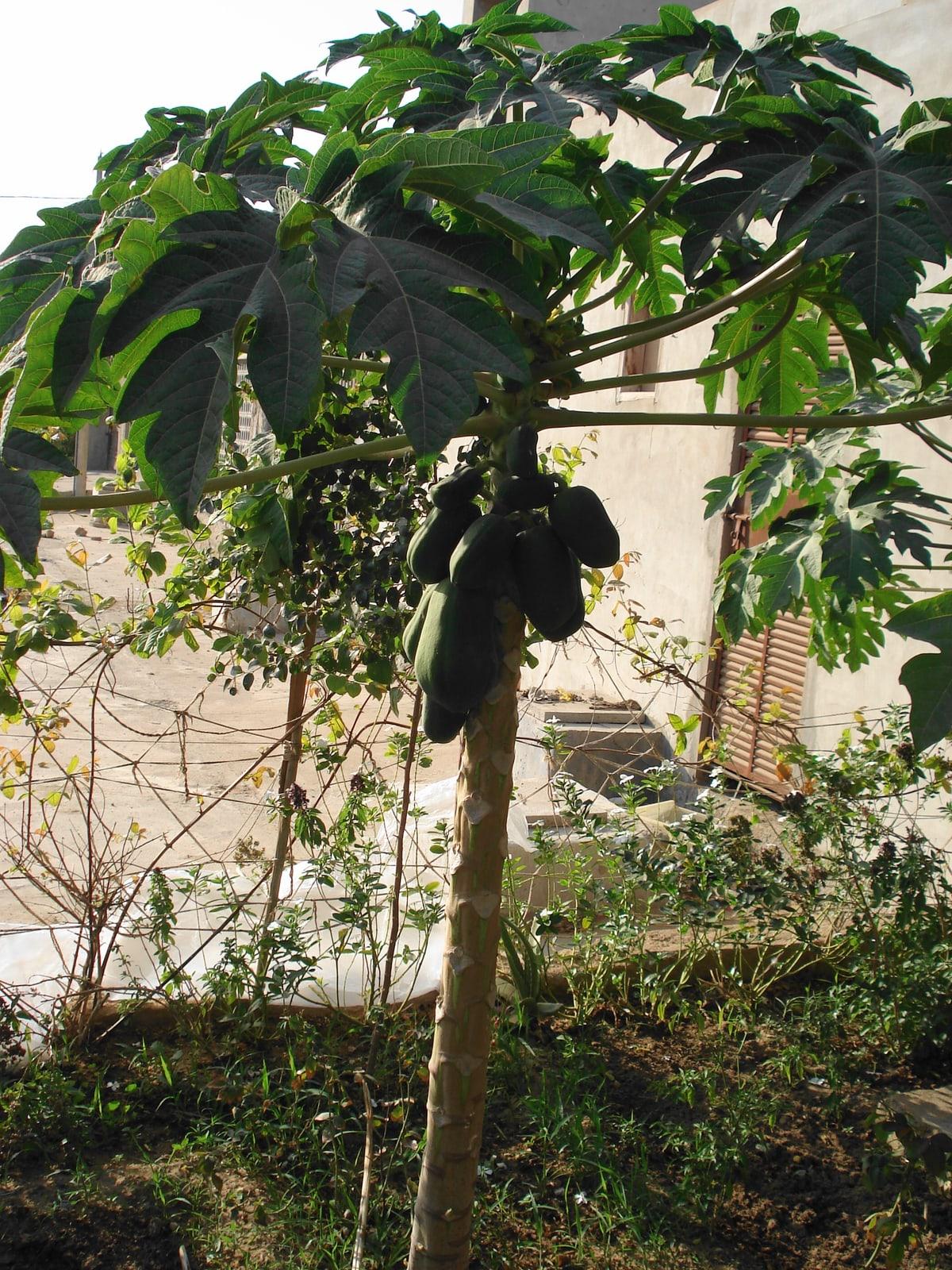
What is perhaps most surprising is that its main ingredients are not Asian at all. Papayas and chillies both come from the Americas, and were brought to Southeast Asia by Spanish and Portuguese explorers. By the end of the 17th century, papaya was already widely grown in Siam, the old name for Thailand. A few centuries later, it became the base of one of the region's most famous dishes.
One Salad, Many Versions
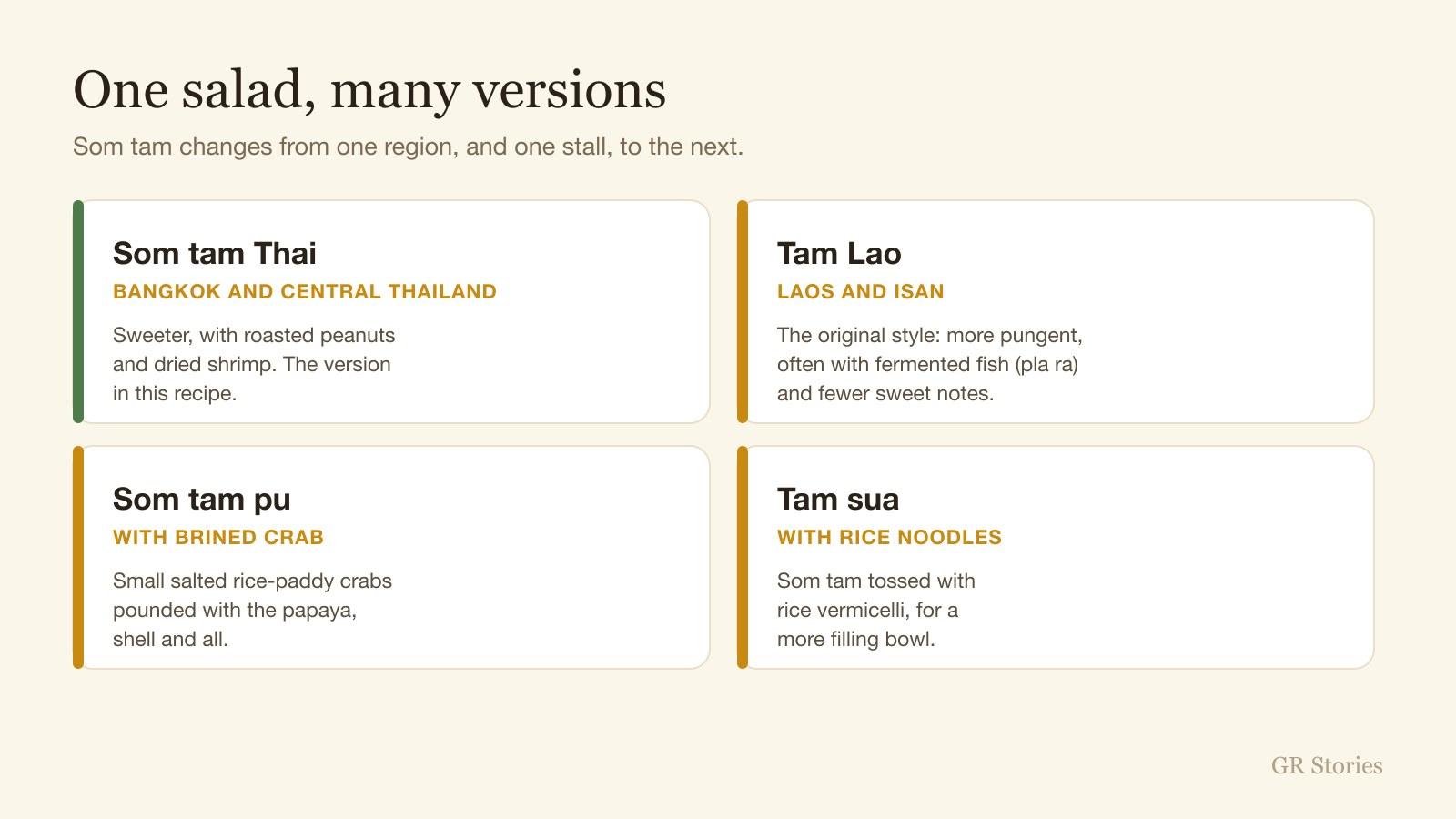
There is no single som tam. Every region, and almost every street vendor, has a version of their own. The one in this recipe is the central Thai style, often called som tam Thai, which is a little sweeter and comes with roasted peanuts and dried shrimp. In Laos and Isan, the original style is usually more pungent and less sweet, and it is often made with fermented fish or brined crabs.
The Four Flavours
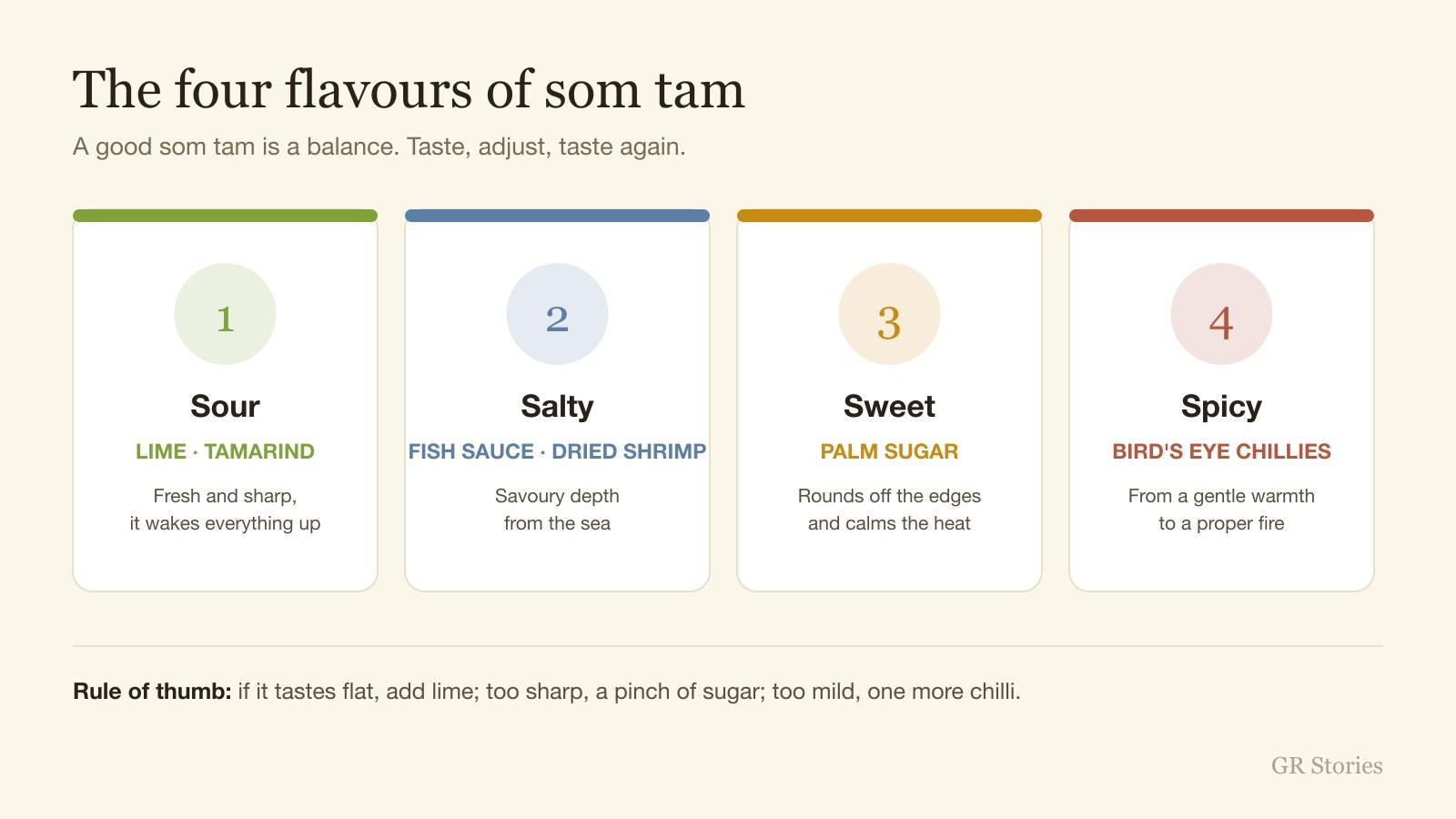
The secret of a good som tam is balance. Lime and tamarind bring the sourness, fish sauce and dried shrimp the saltiness, palm sugar the sweetness and chillies the heat. None of them should win: you want to taste all four in the same mouthful. That is why Thai cooks taste the dressing constantly while they make it, and why the quantities below are a starting point rather than a rule.
Ingredients
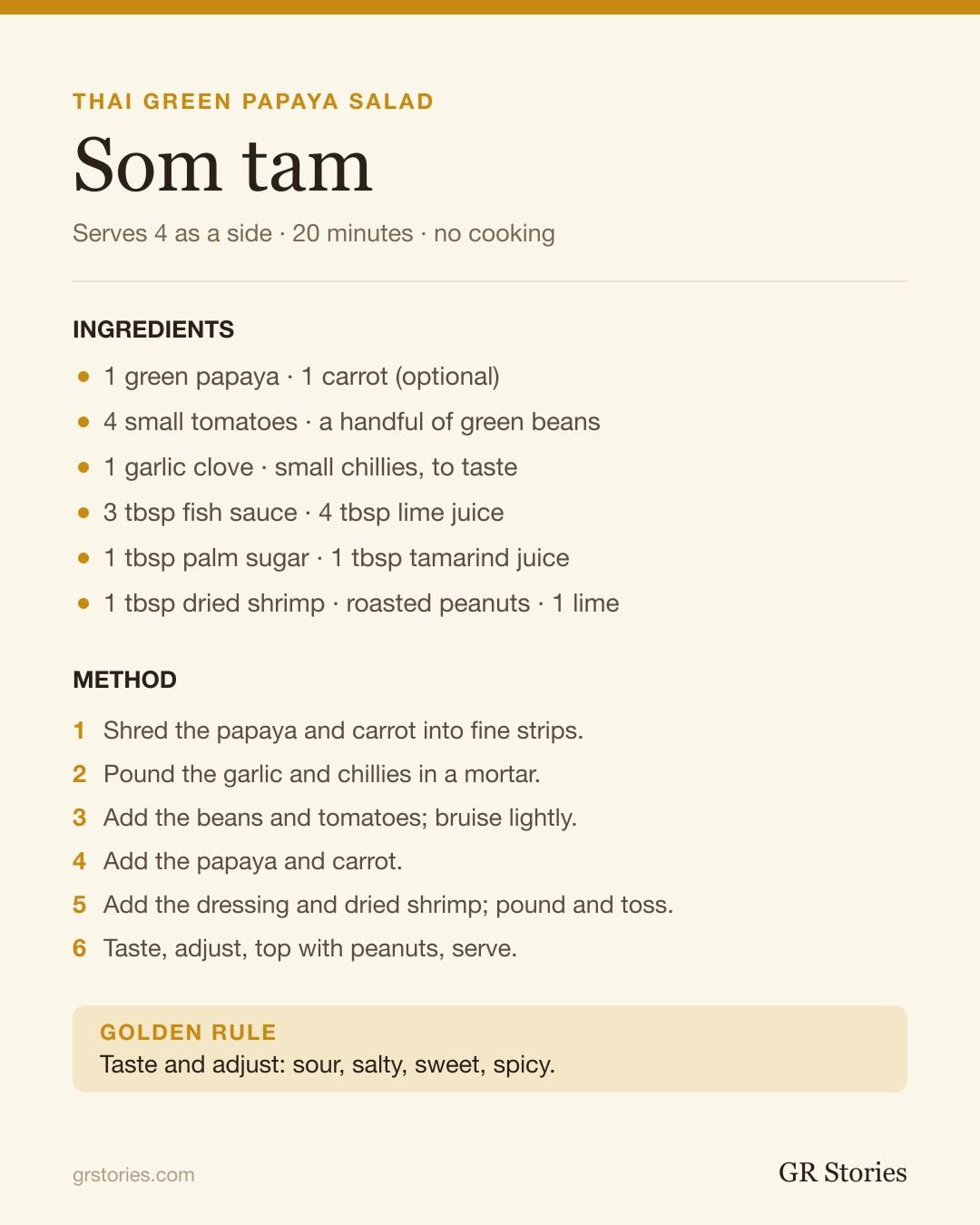
Serves about 4 as a side. Preparation: 20 minutes. No cooking.
- 1 green papaya, shredded or cut into fine julienne strips
- 1 to 12 small chillies, according to your taste (start with one or two if you are not used to Thai heat)
- 1 carrot, shredded (optional, for added colour and crunch)
- 4 small tomatoes, quartered
- 1 handful of green beans, cut into short pieces (yard-long beans if you can find them)
- 1 clove of garlic, crushed
- 3 tablespoons fish sauce
- 4 tablespoons lime juice
- 1 tablespoon palm sugar (or brown sugar)
- 1 tablespoon tamarind juice
- 1 tablespoon dried shrimp
- 1 handful of roasted, unsalted peanuts
- 1 lime, to serve
You will also need a mortar and pestle. A large, deep one is ideal; if yours is small, you can do the first steps in the mortar and finish the salad in a large bowl.
A Note on Ingredients
Green papaya. This is not the sweet, orange fruit you eat at breakfast, but the same fruit picked while it is still hard and green. Inside, the flesh is pale, firm and crunchy, with very little flavour of its own, which is exactly what you want: it soaks up the dressing. Look for it in Asian supermarkets. A sharp julienne peeler makes shredding much easier, but a knife and some patience work too. If you really cannot find green papaya, firm cucumber, kohlrabi or green mango will give you a similar crunch, even if it will not be quite the same dish.
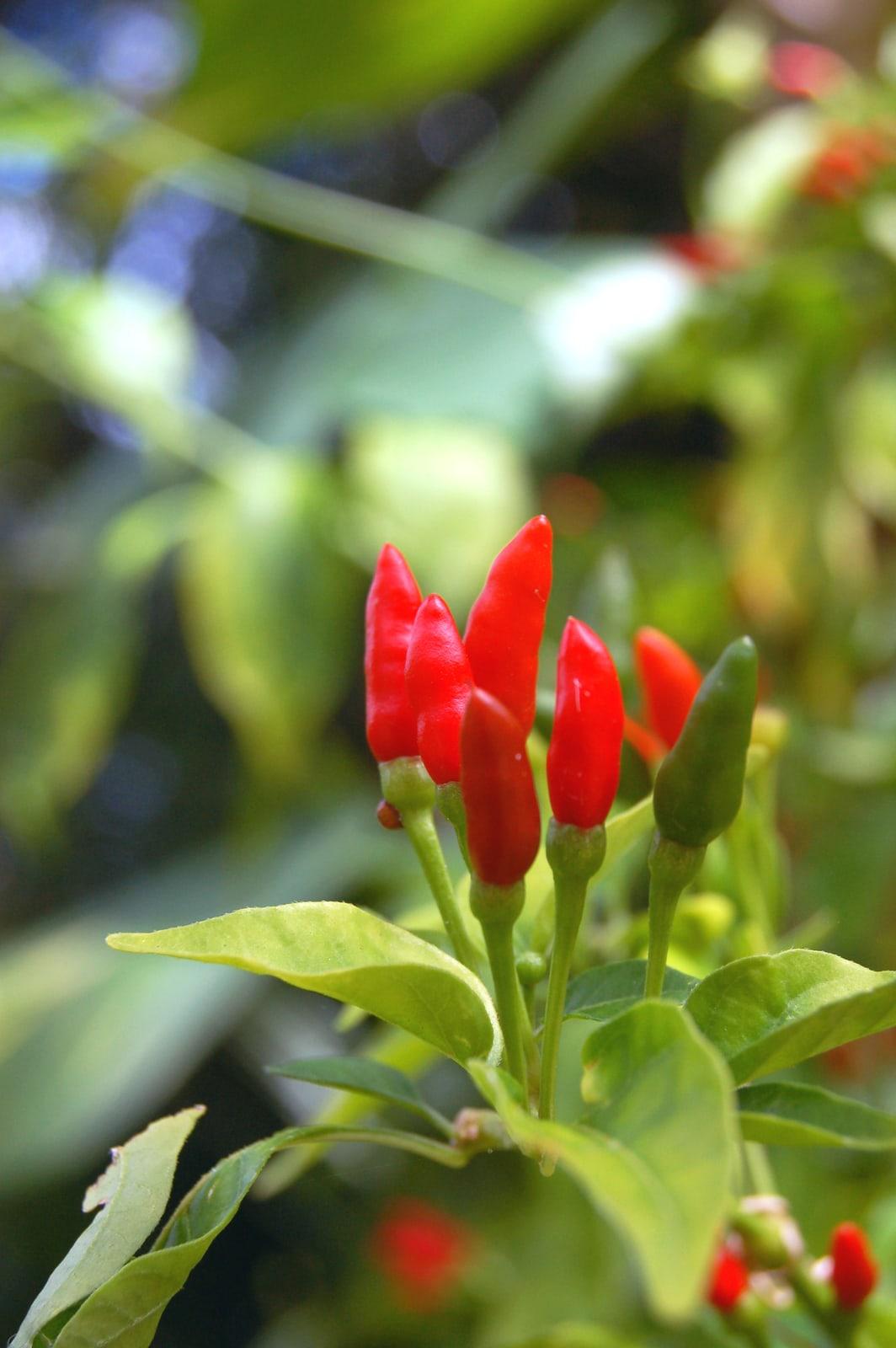
Chillies. Som tam is traditionally made with small bird's eye chillies, which are much hotter than they look. Bangkok street vendors can add a whole fistful; at home, start low and add more after tasting. You can always add heat, but you cannot take it away.
Fish sauce and dried shrimp. These are the salty, savoury backbone of the dish. Fish sauce is strong on its own, but in a dressing with lime and sugar it simply tastes deep and rounded. Dried shrimp add little bursts of flavour and a slightly chewy texture.
Palm sugar and tamarind. Palm sugar is softer and more caramel-like than white sugar; if it comes in a hard block, shave or pound it before adding it. Tamarind juice adds a second, fruitier kind of sourness alongside the lime.
Method
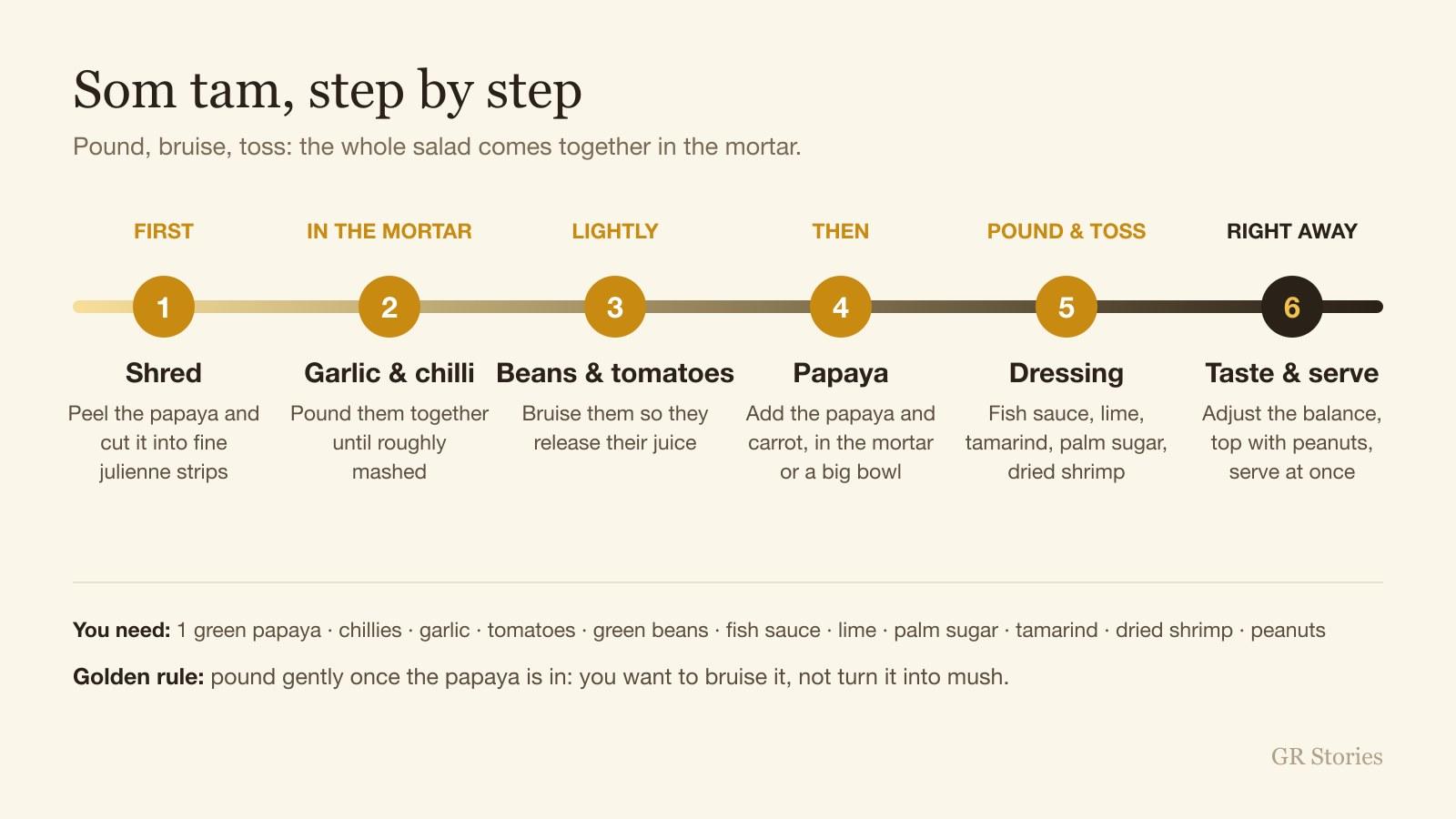
Step 1 — Prepare the papaya
Peel the green papaya, cut it in half and scoop out the white seeds. Shred the flesh or cut it into fine julienne strips. Do the same with the carrot, if you are using it.
Step 2 — Garlic and chillies
Put the garlic and the chillies in the mortar and pound them together until they are slightly mashed. This releases their oils and makes sure their flavour reaches every part of the salad.
Step 3 — Green beans and tomatoes
Add the green beans and the tomatoes and pound them lightly. You are not trying to crush them, only to bruise them so the tomatoes release a little of their juice into the dressing.
Step 4 — Add the papaya
Add the shredded papaya and carrot to the mortar, or move everything into a large mixing bowl if your mortar is too small.
Step 5 — Dress and pound
Add the fish sauce, lime juice, tamarind juice, palm sugar and dried shrimp. Mix, or pound lightly while turning everything over with a spoon, so the papaya absorbs the flavours without turning soft.
Step 6 — Taste, adjust and serve
Taste and adjust the seasoning with more fish sauce, lime juice or sugar as needed. Scatter the roasted peanuts on top, add a wedge of lime and serve immediately, while the papaya is still crunchy.
Common Mistakes (and How to Avoid Them)
- Using ripe papaya. Orange, ripe papaya is soft and sweet. Som tam needs green, unripe papaya.
- Pounding too hard. Once the papaya is in, the idea is to bruise it, not to mash it. Use gentle strokes and turn it with a spoon.
- Making it in advance. Som tam is best eaten straight away. As it sits, the papaya releases water and loses its crunch.
- Not tasting. Limes, fish sauces and chillies all vary. Taste the dressing before serving and adjust it.
- Overdoing the chillies. Start with fewer than you think. You can always pound in one more.
How to Eat It
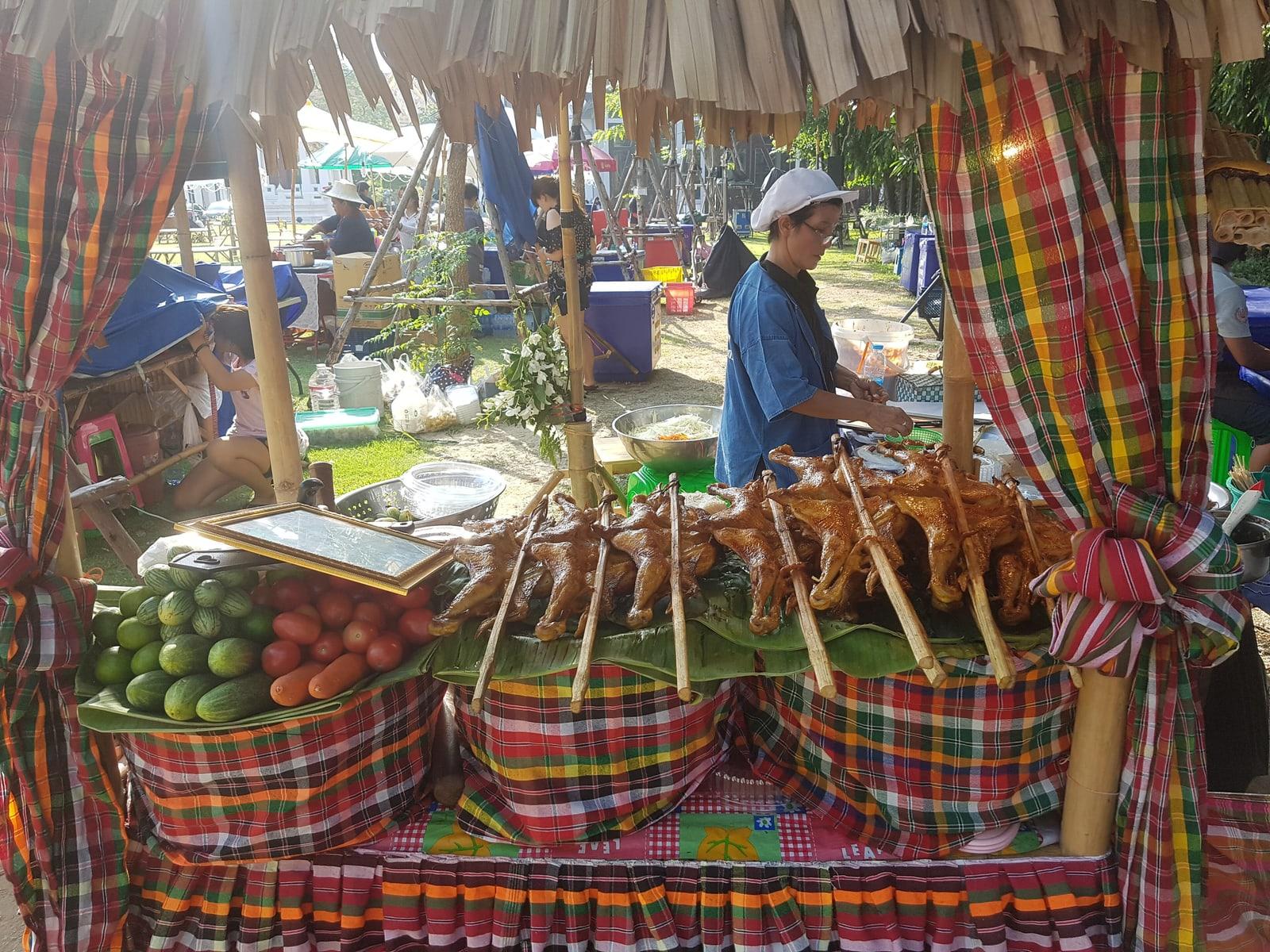
In Thailand and Laos, som tam is rarely eaten on its own. The classic combination is som tam, grilled chicken (gai yang) and sticky rice: you take a small ball of rice with your fingers and use it to pick up the salad and soak up the dressing. Raw vegetables, such as cabbage wedges or long beans, are often served alongside to cool your mouth between bites.
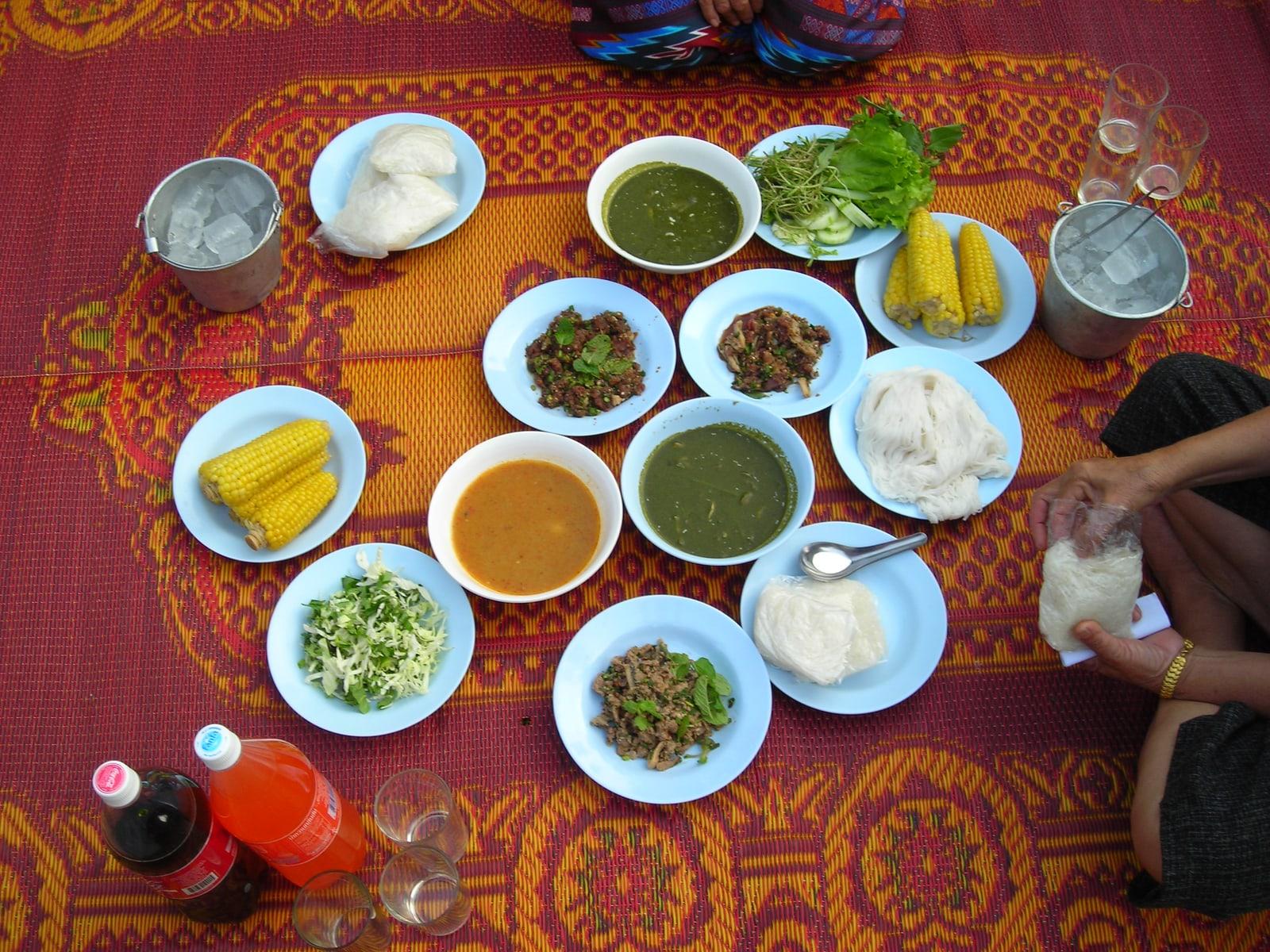
In Isan, som tam is one of many small dishes shared around a mat on the floor, with sticky rice, dipping sauces, grilled meat and fresh vegetables. That is the spirit of the dish: everyone helps themselves, and the mortar goes back to work as soon as the plate is empty.
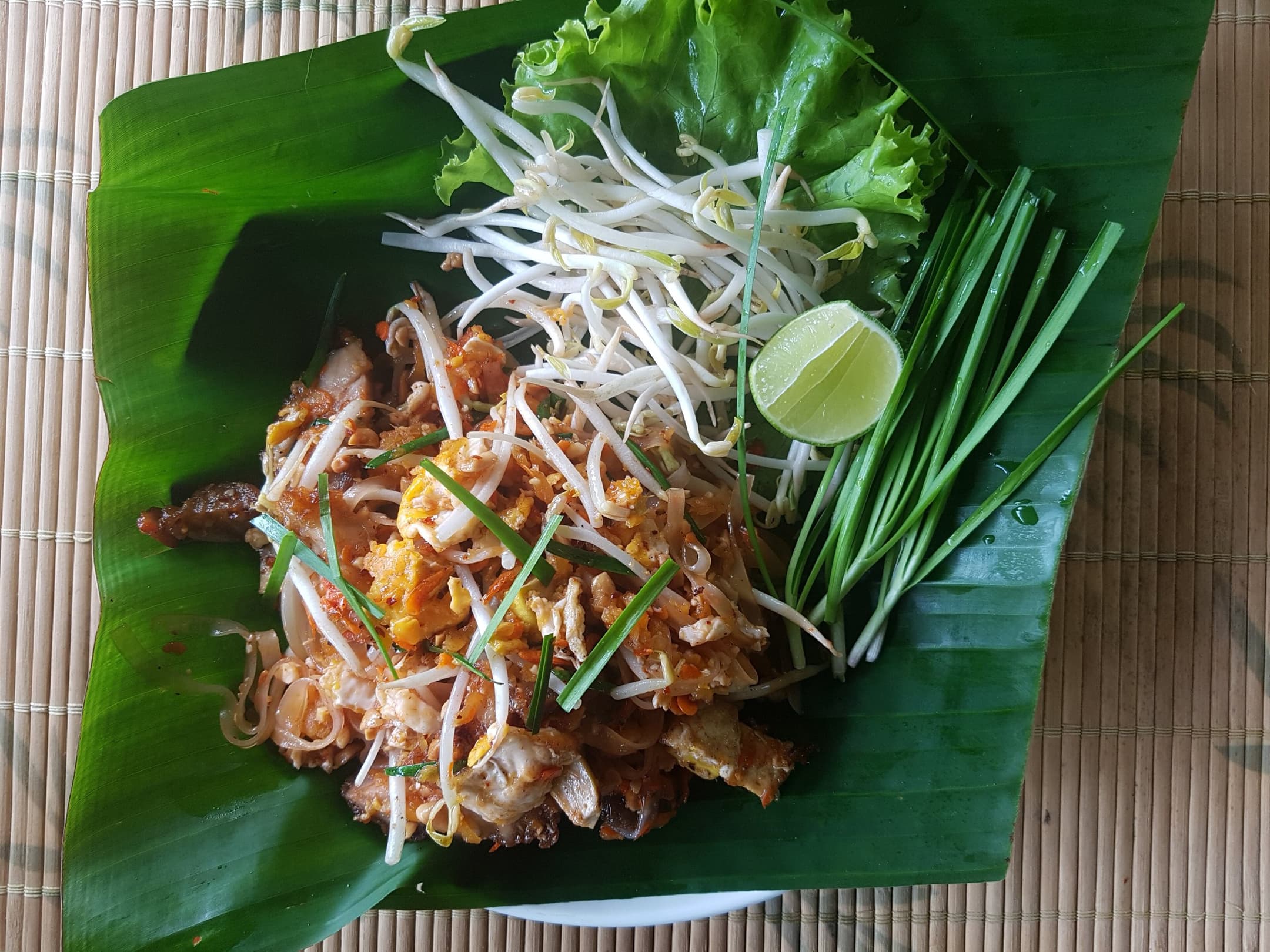
If you want to cook a whole Thai dinner, som tam is the perfect fresh starter before a plate of pad Thai.
Why This Recipe Belongs in a Student Kitchen
Som tam might be the most student-friendly recipe there is. It needs no stove and no oven, so it is perfect for a small flat or a shared student kitchen where the hob is always busy. The ingredients are cheap, and the bottles you buy, fish sauce, tamarind and palm sugar, will last for many more meals. And it is a great dish to share: like fattoush or bibimbap, it is the kind of food that turns a quick dinner into a small trip abroad.
Sources and Photo Credits
- History: Green papaya salad, Wikipedia.
- Cover: Papaya salad (som tam), as sold in Thailand by Index Librorum Permissorum, CC0, via Wikimedia Commons.
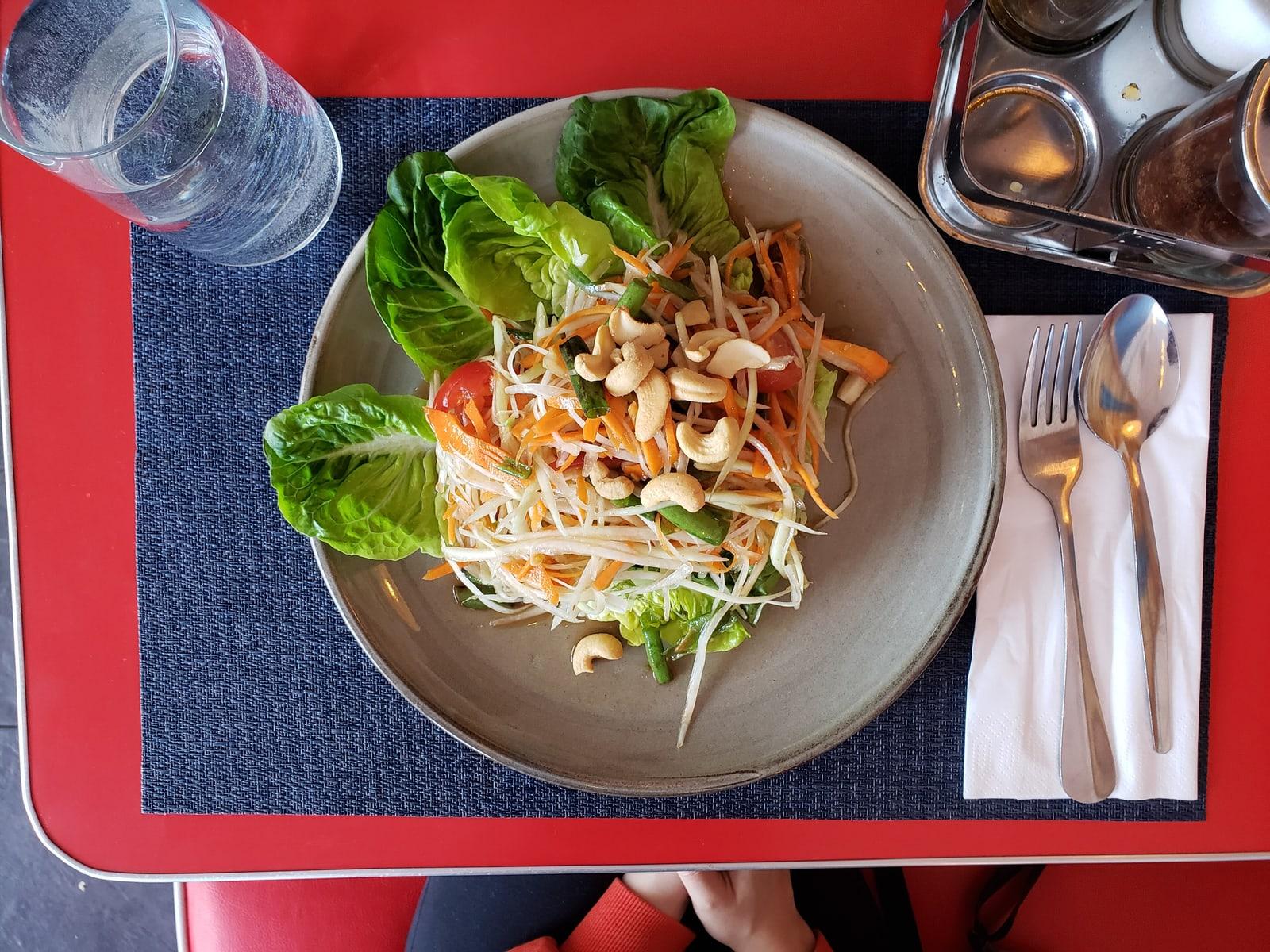
- Som tam plate: Som Tom (Papaya Salad), Little Thai by Andy Li, CC0, via Wikimedia Commons.
- Papaya tree: Papaya plant by Miansari66, public domain, via Wikimedia Commons.
- Chillies: Thai hot peppers by P. Miller, public domain, via Wikimedia Commons.
- Grilled chicken: Grilled chicken, Bangkok National Museum by Iudexvivorum, CC0, via Wikimedia Commons.
- Isan meal: A traditional family breakfast in the Isan, Thailand by Mattes, public domain, via Wikimedia Commons.
- Illustrations: © GR Stories.